
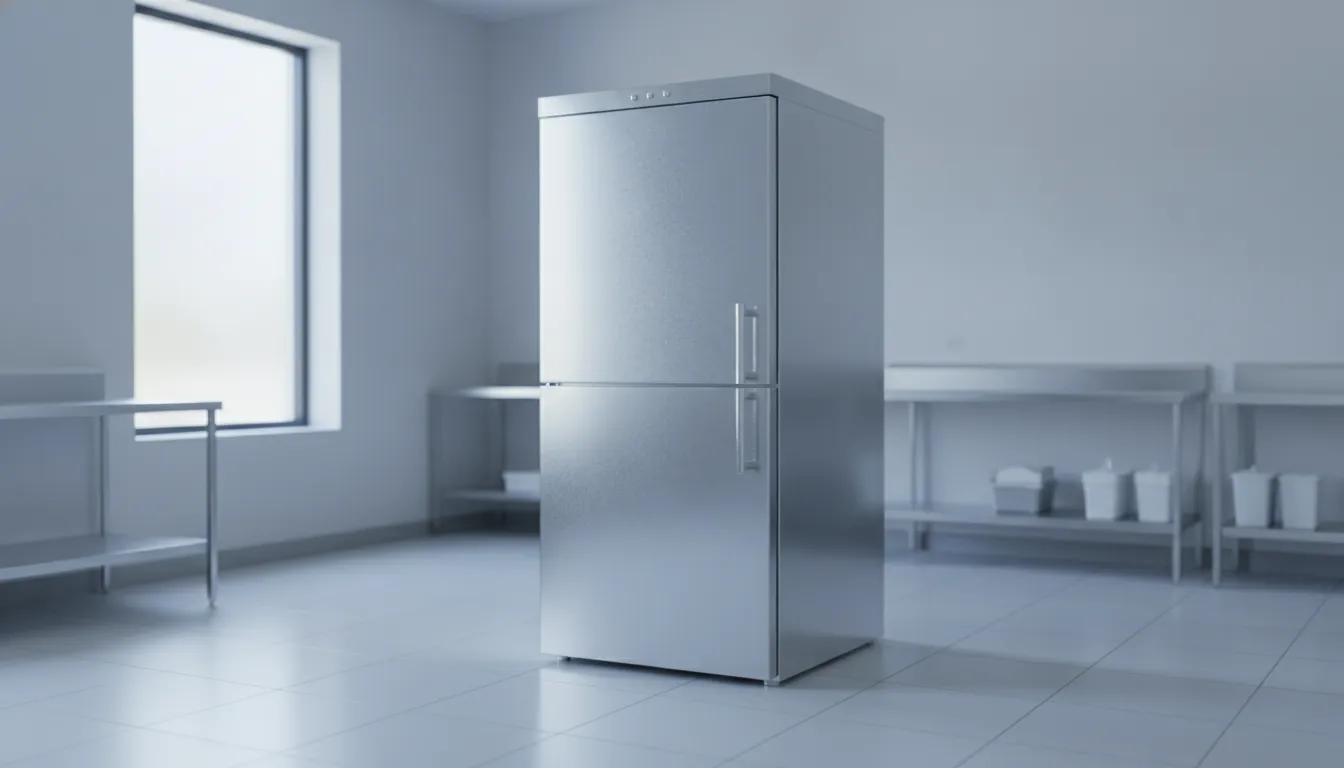
An upright mortuary cooler is the right fit when the room can take a tall cabinet, staff can reach every rack, and the stated body count covers a normal week plus a short surge. It is usually the wrong fit when the ceiling is low, the aisle is tight, or staff need cot-height roll-in loading. Measure height, width, and the delivery path before you compare prices.
Review the 4-body upright cooler
When is an upright mortuary cooler the right choice?
Choose an upright cabinet when floor space is narrow and the ceiling can take the full height, including the cooling unit and casters. Vischer’s smaller upright models are built for rural morgues, hospitals, removal companies, and funeral homes that need a set number of racks in a compact footprint.
The shape does the work. Bodies sit on stacked racks inside one tall box, so the floor footprint stays small while the unit uses vertical space. That helps a prep room that cannot spare a walk-in aisle. It does not help a room where the top rack would sit above a safe working height, or where a cot needs to roll straight into a bay.
Use three checks before you treat any upright model as a match:
- Ceiling. The published exterior height, with the cooling unit and casters if you will use them, must clear the ceiling and any soffit.
- Reach. Staff must be able to load and retrieve every rack without a workaround the team has not practiced.
- Count. The listed body count should cover a typical busy stretch, not only a quiet week.
If any check fails, look at another configuration. The mortuary cooler buying guide compares roll-in, walk-in, modular, and portable options. This page stays on the vertical cabinet decision.
How do Vischer upright models differ?
Vischer lists several MOBI Medical upright cabinets. They share a self-contained refrigeration package on the smaller models, but height, interior width, loading direction, and rack layout are not the same. Read the current product page before you plan a wall around one of them.
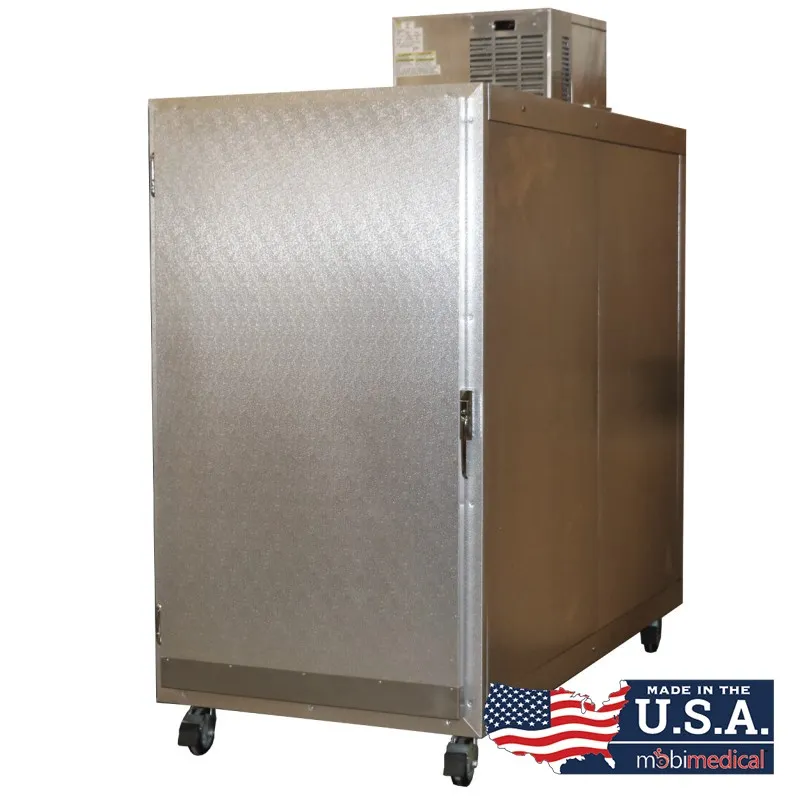
Published starting prices and dimensions below were taken from the live catalog. They can change. Confirm the quote, options, and drawings with Vischer before you order.
| Model | Starting price | Published size | What to notice |
|---|---|---|---|
| 2-body upright style | $8,195 | Dimensions are not published on the listing | Includes a roller rack shelf. Ask for exterior height before you reserve ceiling space. |
| 3-body upright | $8,449 | Exterior about 94 in. deep, 38 in. wide, 83 in. tall with cooling unit and casters | Interior width is about 30 in. Three individual roller rack shelves. Shorter than the 4-body unit. |
| 3-body extra wide | $8,875 | Exterior about 94 in. deep, 44 in. wide, 83 in. tall with cooling unit and casters | Interior width is about 36 in. The listing notes 36 in. of side-to-side door clearance. |
| 3-body side-load upright | $9,195 | Confirm current dimensions on the listing | Side-load access with slide-out shelving. Sold unassembled. Castors and an LED light are options. |
| 4-body upright | $9,349 | Exterior about 94.5 in. deep, 44 in. wide, 105.5 in. tall with cooling unit and casters | Four-tier roller rack. About 98 in. tall with the cooler and no casters. Interior height is about 75 in. |
| 12-body upright | $21,195 | Confirm current exterior dimensions on the listing | Three oversized openings, each listed at 31.5 in. wide, and three 4-tier roller rack units. Split cooling unit. Sold unassembled. |
A higher body count is not automatically a better room fit. The 4-body unit is much taller than the 3-body units. The extra-wide 3-body unit keeps a similar height to the standard 3-body unit and adds interior width. The 12-body unit is a different project: it uses a split cooling unit that needs HVAC and electrical connections, not a simple plug-in box.
Which ceiling and door limits rule a model out?
Rule a model out when its published exterior height, in the exact option set you will buy, does not clear the ceiling, or when the cabinet cannot travel through the delivery path. Height on the listing is not one number. Casters and the cooling unit change it.
On the 4-body upright page, Vischer publishes about 105.5 inches with the cooling unit and casters, and about 98 inches with the cooler and no casters. The 3-body and extra-wide 3-body pages publish about 83 inches with the cooling unit and casters, and about 76 inches with the cooler and no casters. A room that accepts a 3-body cabinet can still reject the 4-body cabinet.
Width is the other hard limit. The standard 3-body interior is about 30 inches wide. The extra-wide 3-body interior is about 36 inches, and that listing calls out 36 inches of door clearance from side to side. If your cases or trays need that extra width, the shorter standard cabinet is the wrong match even when the ceiling is fine.
Walk the delivery path with the same numbers:
- Measure every doorway, turn, and header from the truck to the final wall.
- Decide whether the unit will arrive assembled or as panels.
- Compare that path with the model you picked, not with a smaller photo from another listing.
- Leave the ceiling measurement in writing next to the option set, including casters or no casters.
Vischer states that lift-gate service is not available for these coolers. Assembled and unassembled units need a forklift at delivery if the building has no loading dock. Unassembled panels can sometimes be unloaded by hand, and that choice may add a waiting fee. Do not plan on a lift-gate truck.
How should staff reach each rack?
Staff should be able to load and remove a case from every rack the model includes, using the cot, lift, or board the team already uses. If the top tier only works with an extra step the team has not approved, that capacity is not usable capacity.
Upright racks are stacked. The 4-body listing includes a four-tier roller rack. The 3-body and extra-wide 3-body listings include three individual roller rack shelves. The side-load 3-body listing uses heavy-duty slide-out shelving. Those are different motions. A roller rack and a slide-out shelf do not ask the same thing of the aisle in front of the door.
Stand in the planned footprint and mark the door swing before you order. You need room to open the door, approach with the transfer equipment, and still pass other work in the room. A narrow cabinet can steal the aisle if the door opens across the only path.
Side-load is the variant to study when the long side of the cabinet faces the working aisle and end access is blocked. It is still an upright cabinet, not a roll-in bay. If the workflow depends on rolling a cot into the cooler at cot height, compare a roll-in layout instead of forcing a stacked rack to imitate one.
Rack hardware is a separate choice from the cabinet. If you are deciding trays, boards, or rack spacing inside a cooler you already own, use the cooler rack and body tray guide. Do not let that accessory decision pick the cabinet height for you.
What power and site conditions do these units need?
The smaller Vischer upright coolers are self-contained. The 3-body, extra-wide 3-body, side-load 3-body, and 4-body listings say they need no floor drain and plug into standard 110V power, with no special electrical system. The 12-body upright listing is the exception: its split cooling unit requires HVAC and electrical connections.
Self-contained does not mean the room can be ignored. Every one of these listings tells buyers who will place the cooler in a non-air-controlled space, such as a garage that can exceed 90 degrees Fahrenheit, to purchase the upgraded higher-BTU compressor. Tell Vischer the real summer room temperature before you treat the standard mechanical package as enough.
Also confirm who watches the temperature after installation. Holding a stable cold cabinet is part of the operating plan, not a detail to invent on delivery day. State rules differ. Maryland requires a refrigeration unit used to store human remains to be kept lower than 40 degrees Fahrenheit. North Carolina expects a crematory unit that can hold 40 degrees Fahrenheit while loaded to its design capacity. Virginia requires refrigeration at no more than about 40 degrees Fahrenheit when a body will be stored more than 48 hours before disposition. Check the rule that applies to your license and state. Do not copy another state’s number onto your log.
The smaller cabinets also publish the same warranty pattern: 15 years on panels and doors, 5 years on mechanical parts, and 2 years on parts and labor. The 2-body listing states the panel, door, and mechanical-parts terms. Ask which warranty line applies to the exact 12-body build before you compare it with a plug-in 3-body or 4-body cabinet.
How do you pick one model and order it?
Pick the shortest cabinet that still gives you usable racks, enough interior width, and a delivery path you have measured. Then confirm assembly, casters, and the compressor with Vischer in one written list.
A practical sequence looks like this:
- Write the busiest concurrent count you realistically hold, and the width of the cases or trays you use.
- Measure ceiling height at the exact spot, then subtract the published exterior height for the option set you want.
- If the 4-body height fails and a 3-body count is enough, compare the standard 30-inch interior with the extra-wide 36-inch interior.
- If the aisle favors the long side of the box, review the side-load 3-body listing instead of assuming end access.
- If you need about a dozen spaces and can support a split cooling unit, review the 12-body upright as its own project.
- Send the measurements, photos of the path, and the forklift or dock plan with the quote request.
Browse the full set on the mortuary coolers category page if a vertical cabinet fails the ceiling or reach test. Keep the upright short list only for rooms that pass those checks.
Send your room measurements to Vischer
Frequently asked questions
Is an upright mortuary cooler the same as a walk-in?
No. An upright model is a tall cabinet with stacked racks. A walk-in gives staff an interior aisle and uses more floor area. Use the upright when the footprint is tight and the ceiling can take the cabinet. Use a walk-in or roll-in when staff need to move inside the cooler or roll a cot into a bay.
Why is the 4-body upright so much taller than the 3-body?
The 4-body listing uses a four-tier roller rack and publishes about 105.5 inches of exterior height with the cooling unit and casters. The 3-body and extra-wide 3-body listings publish about 83 inches in that same option set. A ceiling that clears the 3-body cabinet may not clear the 4-body cabinet.
Do these upright coolers need a floor drain or special power?
The 3-body, extra-wide, side-load, and 4-body listings say the refrigeration is self-contained, needs no drainage, and plugs into standard 110V. The 12-body upright uses a split cooling unit and needs HVAC and electrical connections. Hot rooms above 90 degrees Fahrenheit need the upgraded compressor on the listings that state that requirement.
Can the cooler arrive if we do not have a forklift?
Not as a routine lift-gate delivery. Vischer says lift-gate service is not available, and assembled or unassembled coolers need a forklift if you do not have a loading dock. Unassembled panels may be unloaded by hand, which can add a waiting fee. Confirm the plan before the truck is scheduled.
Which upright model should a small funeral home start with?
Start with ceiling height and interior width, not with the largest body count. Many small rooms should compare the 2-body and 3-body cabinets first, then the extra-wide 3-body if 30 inches of interior width is tight. Move to the 4-body only when the taller exterior height and four-tier reach both work.