

In a preparation room, waiting for a surface to look dry is not the same as making it safe. Blood or other potentially infectious materials can remain a concern after visible moisture disappears. So cleaning decisions should follow the exposure risk, the surface, the contaminant, and your facility’s written procedures.
Contact Vischer for help selecting practical safety supplies and PPE.
For teams asking how long can bloodborne pathogens survive on a surface, there is no universal clock. Hepatitis B virus, for example, can survive in dried blood on an inanimate surface for at least one week. While survival varies with the material, temperature, humidity, and organic matter present. Research on HBV persistence supports treating potentially contaminated surfaces promptly rather than relying on elapsed time.
That distinction gives funeral-home teams a sound starting point: identify where exposure could occur, use appropriate PPE, and select a cleaning and disinfection process that matches the risk. The science behind surface persistence helps explain why those controls matter, especially in high-touch areas and during spill response.
How Long Can Bloodborne Pathogens Survive on a Surface?
There is no universal survival clock for bloodborne pathogens on a surface. Persistence depends on the specific organism, the material, temperature, humidity, and the amount of organic matter present. A dry appearance is not a reliable safety test, so funeral home staff should treat a surface as potentially contaminated until it has been properly cleaned and decontaminated.
The clearest benchmark in the assigned research concerns hepatitis B virus (HBV). HBV is highly persistent and can survive in dried blood on inanimate surfaces for at least one week. According to a peer-reviewed review of HBV and other bloodborne pathogens. Read the source on HBV persistence.
That benchmark should be used as a reason for disciplined controls, not as a prediction for every situation. It does not mean that every pathogen remains infectious for the same length of time, or that a surface becomes safe at the end of seven days. It also does not establish a safe waiting period for a preparation room, embalming table, stretcher, instrument, floor, or frequently handled touchpoint.
Why conditions make timing difficult to predict
Surface survival is affected by several interacting conditions. The same biological material may behave differently on stainless steel, a porous item, painted equipment, plastic, fabric, or another surface. Temperature, humidity, surface material, and organic matter can all influence persistence. The research review explains these variables in more detail: see the review of microorganism survival on inanimate surfaces.
- Organism: Different bloodborne pathogens have different environmental persistence profiles.
- Surface: Material and condition can affect how fluid dries, remains present, or is removed.
- Environment: Temperature and humidity influence drying and survival conditions.
- Contamination: Organic matter can change how readily cleaning and disinfection work.
Why survival does not equal likely transmission
Finding that a pathogen can persist does not by itself measure the likelihood of transmission. Transmission also depends on whether viable material is transferred, the route of exposure, the amount involved. And whether a worker has a relevant contact with mucous membranes, non-intact skin, or a sharps injury. In practice, persistence is one part of the hazard assessment, not a stand-alone risk calculation.
Indirect transmission through contaminated surfaces is still a reason to control high-touch areas. A peer-reviewed review notes that frequently touched contaminated surfaces can allow transfer from an infected source to another person. Review the evidence on surface-mediated transmission. For funeral homes, the practical response is prompt risk-based cleaning and disinfection under the facility’s exposure control plan. Product label, and standard operating procedures, rather than waiting for a presumed survival period to expire.
Which Conditions Change Surface Survival?
Surface survival is not governed by a single countdown. Material, temperature, humidity, organic matter, moisture, contamination level, and touch frequency can all change the practical risk. Treat an affected surface according to the contamination and exposure scenario, rather than assuming that drying or elapsed time makes it safe.
Surface material matters because a smooth, nonporous work surface does not behave exactly like fabric, unfinished wood, grout, or a piece of equipment with seams and joints. The texture and porosity can affect how fluid is retained and how thoroughly a cleaning solution reaches the affected area. Temperature and humidity also influence environmental persistence. The peer-reviewed review identifies surface material, temperature, humidity, and organic matter as important factors in pathogen survival.
Organic matter, including blood or other body fluids, can complicate cleaning by shielding contamination from a disinfectant. A wet deposit, a partially dried deposit, and a fully dried residue may require different physical handling. But none should be treated as harmless solely because it appears dry. The amount and distribution of contamination matter as well. A small spot in an isolated area presents a different cleaning situation from extensive contamination across a preparation table, floor, handle, or instrument surface.
In a funeral home, risk assessment should account for more than persistence alone. The CDC recommends considering the probability of contamination, the vulnerability of people who may be exposed, and the potential for exposure, including whether a surface is touched frequently. Use that assessment to determine the cleaning frequency and method, while following the facility exposure control plan, SOPs, and the disinfectant label.
- Surface: Consider whether the material is smooth, porous, textured, sealed, or difficult to clean at seams and joints.
- Environment: Note temperature and humidity conditions instead of applying a universal survival estimate.
- Fluid and state: Treat visible blood or OPIM as contamination whether it is wet, drying, or dried.
- Amount: Escalate the response for broad, heavy, or repeatedly deposited contamination.
- Touch frequency: Prioritize handles, controls, rails, faucets, switches, and other frequently touched surfaces.
Touch frequency affects the chance that contamination will move from an inanimate surface to hands, gloves, tools, or another surface. Research on contaminated environments notes that frequently touched surfaces can support indirect transmission. While CDC guidance states that high-touch surfaces require more frequent and rigorous cleaning than low-touch surfaces. In practice, prompt isolation, appropriate PPE, removal of visible material, cleaning, and label-directed disinfection are more reliable controls than waiting for a supposed survival window to expire.
What Does OSHA Consider a Contaminated Surface?
Answer capsule: Under OSHA’s bloodborne pathogens standard, a surface is contaminated when blood or other potentially infectious materials, or OPIM, are present or reasonably anticipated. Treat the area as a hazard based on the work and the potential for exposure, not on whether the material is still visibly wet.
OSHA defines bloodborne pathogens as pathogenic microorganisms present in human blood that can cause disease. Its definition of blood includes human blood, blood components, and products made from human blood. In a funeral home, that context can apply to preparation-room surfaces, instruments, transport equipment, and other areas where employees may encounter blood during preparation, removal, or cleanup. The standard applies to occupational exposure to blood or OPIM. So the relevant question is whether a worker could reasonably come into contact with those materials while performing assigned duties.
What do blood and OPIM mean in practice?
Blood is the OSHA-defined material described above. OPIM is the broader regulatory category for other potentially infectious materials identified by the standard. Staff should use the facility’s exposure control plan and applicable OSHA definitions rather than deciding that a fluid is safe because it looks clear or because a surface has dried. When the source or material is uncertain, follow the facility’s established precautions and escalation process.
When should a surface be treated as contaminated?
OSHA’s definition includes both actual and reasonably anticipated presence. That matters in routine operations. A preparation table with visible blood is plainly contaminated, but a nearby handle, cart rail. Faucet, or instrument area may also require controls when splashing, contact, or transfer is reasonably anticipated. Sharps add a separate injury concern. OSHA defines contaminated sharps to include objects such as needles, scalpels, broken glass, and other contaminated objects capable of penetrating skin.
- Restrict access until the area can be handled under the facility’s procedure.
- Use the PPE and work practices specified in the exposure control plan.
- Assume contamination where blood or OPIM may have transferred, including high-touch points.
- Keep sharps out of ordinary waste and place them in the designated sharps container.
- Clean and disinfect according to the product label and facility SOP, then perform hand hygiene.
OSHA calls the process decontamination when physical or chemical measures remove, inactivate, or destroy bloodborne pathogens so the item or surface is safe for handling, use, or disposal. That is different from simply waiting for a spill to dry. For broader facility requirements, see Vischer’s bloodborne pathogens OSHA compliance guide for funeral homes. This section is educational, not legal advice. Have your responsible safety professional review the exposure control plan, product selection, and procedures for your facility.
A Practical Funeral Home Surface-Cleaning Workflow
Answer capsule: Treat a potentially contaminated surface as a work-control issue, not a countdown. Restrict access, select task-appropriate PPE, remove hazards and visible material, clean, disinfect according to the product label, dispose of waste correctly, wash hands, and document the work.
There is no reliable universal answer to how long can bloodborne pathogens survive on a surface. Survival depends on the organism, surface material, temperature, humidity, and organic matter. That uncertainty is why a funeral home’s response should begin when contamination is identified or reasonably anticipated, rather than after a particular amount of drying time.
The sequence below is a practical framework for preparation rooms, removal areas, and other workspaces. Adapt it to the facility’s exposure control plan, written SOPs, the surface material, and the disinfectant manufacturer’s directions.
- Restrict the area. Pause nearby work and limit access until the surface has been assessed and the response is complete. Keep people from tracking contamination into clean areas. If the situation involves a significant spill, unusual material, or an exposure incident, use the facility’s incident-response process and seek appropriate supervisory guidance.
- Put on task-appropriate PPE. Select gloves, protective clothing, and eye or face protection based on the anticipated contact, splash potential, and cleaning task. OSHA identifies PPE, handwashing, work-surface cleaning, and sharps disposal as infection-prevention measures. But those controls should operate together rather than as a substitute for the facility’s complete exposure control plan. See Vischer’s funeral-home PPE requirements guide for related planning considerations.
- Identify and control sharps first. Look for needles, scalpels, broken glass, or other objects that can penetrate skin. Do not pick them up with bare hands or reach blindly through contaminated material. Use the approved tool and sharps container for the facility, and escalate an unexpected or unsafe condition before continuing.
- Remove visible blood or other potentially infectious material. Use the facility’s spill supplies and a method that limits splashing and aerosolization. Place cleanup materials into the designated waste stream. The CDC’s bloodborne pathogens spill-kit and cleanup job aid provides a reference for kit contents and blood or OPIM spill cleanup steps.
- Clean the surface. Remove remaining soil with the approved cleaner and process for that surface. Cleaning is important because organic material can interfere with some disinfection processes. Work in a controlled direction, change materials as required by the SOP, and avoid spreading soil to handles, equipment controls, or adjacent clean areas.
- Disinfect exactly as the product label directs. Use a product appropriate for the surface and intended claim. Follow the labeled dilution, application method, wet contact time, ventilation requirements, and compatibility warnings. Do not mix chemicals or assume that a surface is safe merely because it looks dry. OSHA defines decontamination as physical or chemical measures that render a surface safe for handling, use, or disposal. CDC cleaning guidance also supports more frequent and thorough cleaning when contamination or area risk is higher.
- Dispose of materials and remove PPE safely. Segregate contaminated waste according to the facility’s plan and applicable requirements. Remove PPE in a way that avoids touching contaminated surfaces with bare hands, and replace or reprocess reusable equipment according to its instructions.
- Perform hand hygiene and document the response. Wash hands with soap and running water after PPE removal and whenever contamination is possible. Record the date, area, responsible worker, observed condition, product and process used, and any follow-up required. Review the event if it reveals a gap in supplies, training, signage, or the cleaning schedule.
Risk should determine how often this workflow is used. Frequently touched areas and heavily contaminated surfaces warrant more rigorous attention than low-touch or lightly contaminated areas. The goal is a consistent, verifiable process that protects staff while preserving the dignity and professional standards of the facility.
How Should a Blood or OPIM Spill Be Handled?
Answer capsule: Treat a blood or OPIM spill as an active exposure-control event, not as ordinary housekeeping. Restrict access, use appropriate PPE, control sharps, remove the material safely, and disinfect according to the product label and your facility’s exposure control plan.
Elapsed drying time does not make a contaminated surface safe. OSHA defines a contaminated surface as one with blood or other potentially infectious materials present, or reasonably anticipated to be present. Its definition of contaminated sharps includes objects such as needles, scalpels, broken glass, and other items that can penetrate the skin.
| Situation | Immediate priority | Response approach |
|---|---|---|
| Routine contamination | Prevent spread during scheduled work | Use the assigned PPE and cleaning process in the facility SOP. Clean and disinfect visibly contaminated and frequently touched surfaces as directed by the product label. |
| Active blood or OPIM spill | Restrict access and protect workers from contact or sharps | Pause nearby work, retrieve the spill kit, use spill-specific PPE, remove visible material, disinfect the area, dispose of waste correctly, and report any exposure or injury. |
The CDC bloodborne-pathogens spill job aid is a useful reference for spill-kit contents and the cleanup sequence. Keep the kit stocked where staff can reach it without crossing the contaminated area. PPE should match the task and the foreseeable route of exposure. Vischer’s funeral home PPE guide can help with the broader selection process, but the exposure control plan and task-specific risk assessment remain the controlling documents.
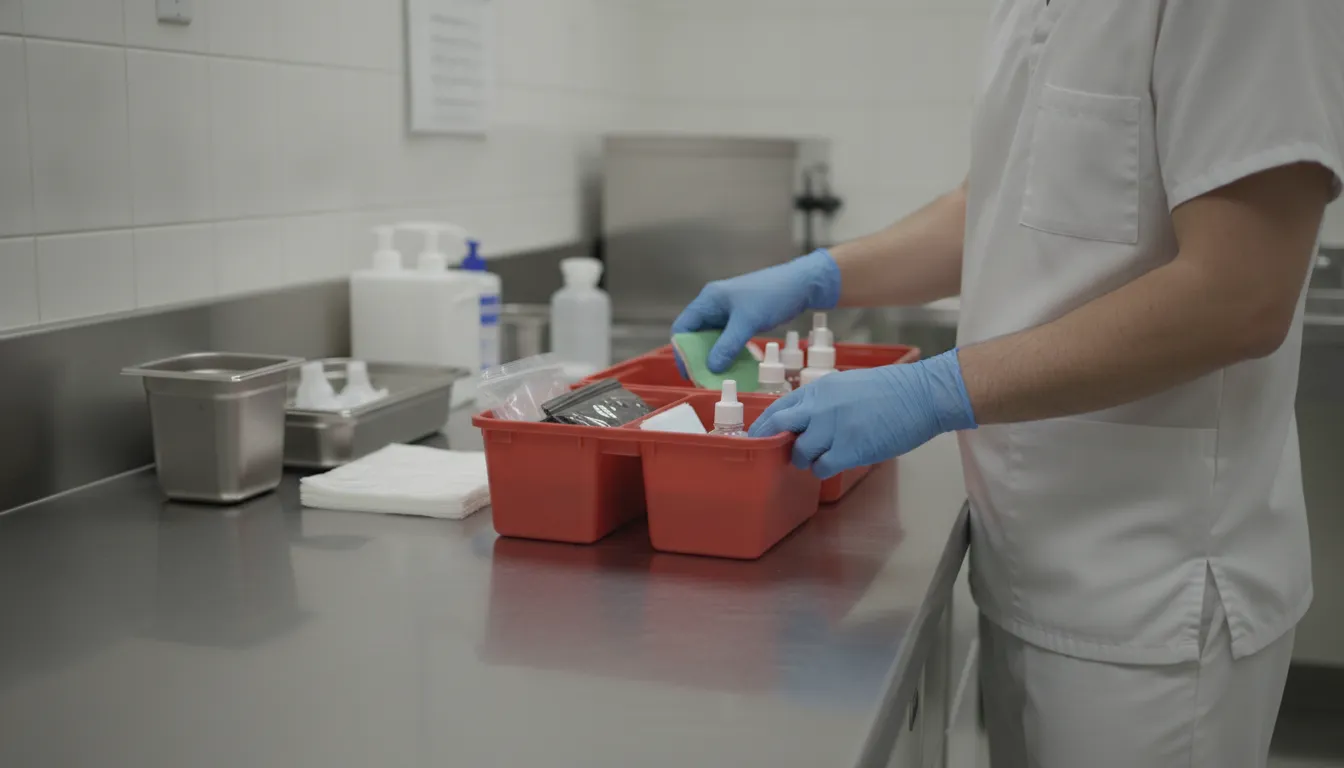
- Stop and isolate the area. Keep coworkers, visitors, and families away until the response is complete. Do not allow anyone to walk through or track material beyond the spill.
- Put on the required PPE. Select gloves and protective clothing appropriate to the volume and splash risk. Add eye and face protection when splashing is possible. Inspect PPE before use.
- Look for sharps without reaching into the spill. Never pick up needles, scalpels, broken glass, or similar objects with your hands. Use the approved mechanical means and sharps container specified by your SOP.
- Remove visible blood or OPIM. Use the materials in the spill kit and avoid actions that aerosolize or spread the contamination. Bag contaminated disposable materials as required by your waste procedure.
- Clean and disinfect. Follow the disinfectant label for dilution, application, compatibility, and required wet contact time. Do not improvise a universal bleach ratio or contact time, and never mix chemicals.
- Finish the response. Dispose of waste and remove PPE according to the exposure control plan. Wash hands with soap and running water, then document the incident and promptly escalate any skin, eye, mucous-membrane, or sharps exposure for the required follow-up.
For routine work, cleaning frequency should reflect contamination probability, exposure potential, and the amount of traffic through the area. For a heavily contaminated or higher-risk space, use the more rigorous process required by the facility SOP and applicable OSHA requirements.
PPE, Product Labels, and Contact Time
Answer capsule: Choose PPE for the task and anticipated exposure, then follow the disinfectant label exactly, including its required wet contact time. Do not treat drying, guessing, or chemical mixing as a substitute for decontamination.
PPE is one layer in a broader exposure-control process. OSHA identifies PPE, handwashing, work-surface cleaning, and proper sharps disposal as infection-prevention measures. But it cautions that the highlighted controls alone will not typically protect workers from infection hazards. Use them together with your facility’s exposure control plan, SOPs, training, and cleanup procedures.
Start with the task, not a one-size-fits-all uniform. Consider whether staff may contact blood or other potentially infectious materials, whether splashes could reach the eyes or face, and whether clothing or footwear could become contaminated. Gloves may be appropriate for hand contact, while tasks with splash potential may require additional protection selected under the facility’s PPE assessment. Review Vischer’s facility PPE requirements and safety equipment guide as a practical companion, then confirm the final selection against your written procedures.
- Inspect PPE before use and replace damaged or contaminated items according to your SOP.
- Put on and remove PPE in a way that limits contact with contaminated surfaces.
- Keep hand hygiene in the workflow. Gloves do not replace handwashing.
- Handle sharps with controls designed for sharps. Never reach blindly into cleanup materials.
Product labels govern the disinfectant step. Read the label for the surfaces and organisms covered, preparation instructions, compatibility warnings, required application method, and contact time. Contact time is the period the treated surface must remain visibly wet for the product’s label directions to work as stated. A quick wipe that leaves the surface dry may not satisfy those directions. Do not invent a dilution, shorten the labeled time, or assume that a product approved for one surface is suitable for another.
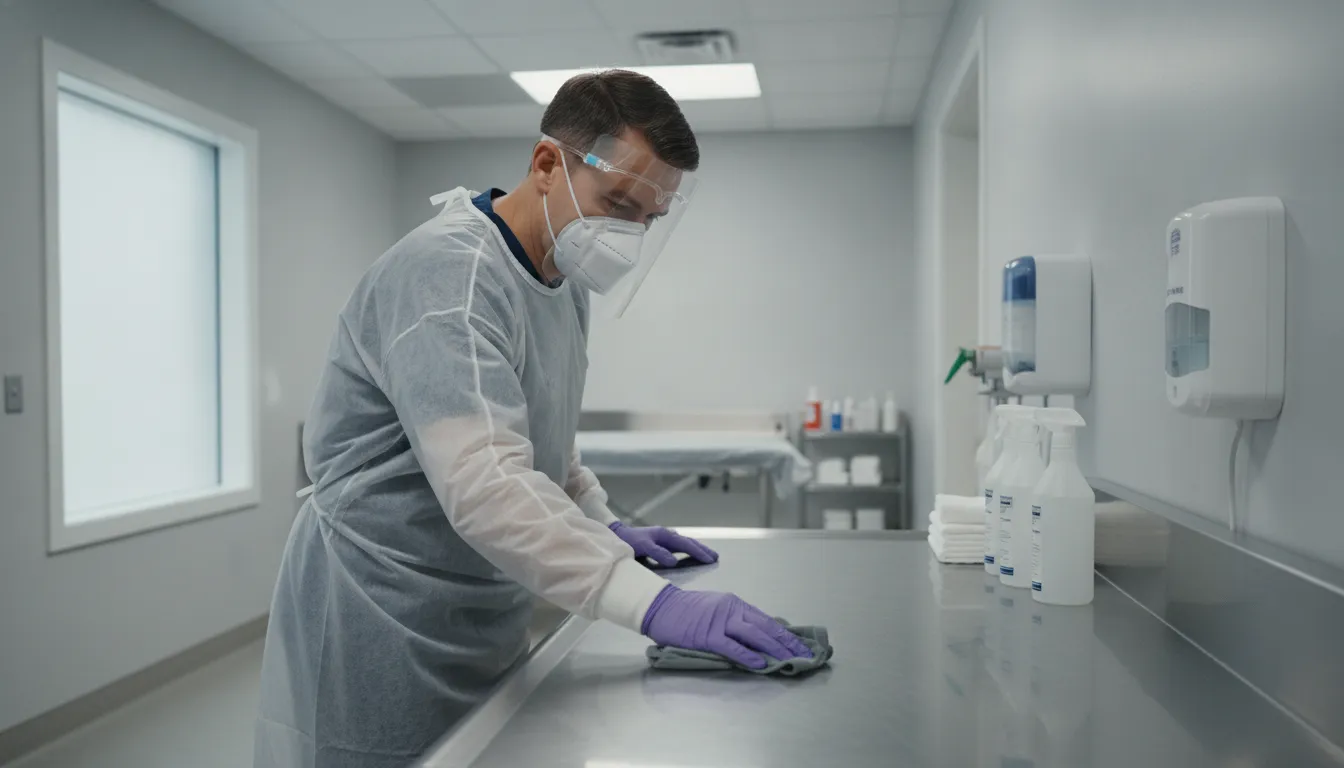
Never mix disinfectants or combine a disinfectant with another cleaner unless the product label specifically directs that process. Mixing can create unexpected hazards and can also undermine the intended procedure. If visible blood or organic material is present, follow the cleaning sequence in your SOP and then apply the selected disinfectant as directed. OSHA defines decontamination as physical or chemical measures that remove, inactivate, or destroy bloodborne pathogens until the surface is safe for handling, use, or disposal. OSHA’s housekeeping guidance identifies surface cleaning and PPE as parts of prevention, while CDC cleaning guidance calls for more frequent and rigorous cleaning in higher-risk areas.
The question of how long can bloodborne pathogens survive on a surface should prompt disciplined controls, not a countdown. Because persistence and exposure conditions vary, staff should not infer safety from elapsed time or visible dryness. Use the label, the facility’s risk assessment, and the documented workflow every time. For product-selection context, see Vischer’s funeral home disinfectants guide.
What Should Funeral Homes Document?
A useful record shows what was cleaned, why it was cleaned, how the work was performed, and whether any exposure or safety issue required follow-up.
Documentation should support the facility’s exposure control plan and standard operating procedures, not create paperwork for its own sake. A cleaning schedule should identify the responsible person, frequency, method, product or process, and detailed SOP for the area or equipment. This structure follows CDC environmental-cleaning guidance: review the CDC cleaning schedule recommendations and adapt them to your preparation room, removal workflow, transport equipment, and other work areas.
Build a practical cleaning record
For routine work, record the date, approximate time, room or equipment, staff member, reason for cleaning, and the product or process used. Note whether the task was scheduled, prompted by visible blood or other potentially infectious material, or performed after a procedure. The record should point staff to the applicable SOP, including preparation steps, required PPE, surface compatibility, dilution instructions, contact time, disposal method, and hand hygiene requirements. Do not invent a retention period for these records. Instead, follow your exposure control plan, applicable OSHA requirements, and your organization’s recordkeeping policy.
- Cleaning area, surface, or equipment identified clearly.
- Responsible person and date or time recorded.
- Frequency and reason for the task documented.
- Product, process, and applicable SOP identified.
- Visible contamination, spill, or unusual condition described factually.
- PPE problems, sharps, damaged containers, or disposal concerns noted.
- Supervisor notification or corrective action recorded when needed.
Record incidents and exposure follow-up separately
A visible spill, puncture hazard, splash, torn glove, or unexpected contamination deserves more than a routine checkmark. Record the area, what was observed, immediate controls, cleanup or disposal steps, and who was notified. OSHA defines an exposure incident around contact with blood or other potentially infectious materials involving the eye, mouth, mucous membrane, non-intact skin, or parenteral route. If that occurs, follow the facility’s exposure-response procedure promptly and document the notification and follow-up actions without adding speculative medical conclusions. OSHA’s guidance notes that employers must comply with the bloodborne pathogens standard when occupational exposure is reasonably anticipated; review OSHA’s housekeeping biological-hazards guidance alongside the standard.
Use incident documentation to improve the system. A repeated spill near the same workstation may indicate a storage, workflow, sharps-control, or PPE issue. The CDC’s bloodborne-pathogens spill-kit and cleanup job aid connects cleanup with exposure response, reporting, and the exposure control plan. That makes it a useful reference when reviewing whether your forms, supplies, and escalation steps match the work being performed.
Ready to strengthen your preparation-room cleaning process? Contact Vischer today.
Frequently Asked Questions
Does a dry surface mean bloodborne pathogens are no longer a concern?
No. Drying is not a decontamination step. HBV can survive in dried blood on an inanimate surface for at least one week, and persistence varies by organism and conditions. Restrict access and follow the facility’s cleaning and exposure-control procedure. Academic review of HBV persistence
What factors affect how long a pathogen survives on a surface?
Surface material, temperature, humidity, organic matter, and touch frequency can affect persistence and transmission risk. Because there is no universal clock, use a risk-based cleaning and disinfection process rather than relying on elapsed time. Review of environmental surface transmission
What should staff do when blood or OPIM is found?
Restrict access, use task-appropriate PPE, control sharps without handling them bare-handed, remove visible material, clean, and disinfect according to the product label and facility SOP. The CDC spill-kit and cleanup job aid is a useful reference for blood or OPIM spills.
How often should funeral-home surfaces be cleaned?
Frequency should reflect contamination probability, exposure potential, and touch frequency. CDC guidance supports more frequent and rigorous cleaning for high-touch or heavily contaminated surfaces. Document the schedule, product, process, and responsible worker in the facility SOP. CDC environmental cleaning procedures
Where can a funeral home review broader bloodborne-pathogen requirements?
Review OSHA’s Bloodborne Pathogens Standard and your exposure control plan. Vischer’s OSHA compliance guide for funeral homes provides broader operational context, while this article focuses on surface survival and cleanup decisions.
Build a More Consistent Cleaning and PPE Process
Surface safety depends on more than knowing that pathogens can persist. Your team also needs the right protective equipment, a clear spill-response plan, compatible products, and written procedures that staff can follow under pressure.
Vischer Funeral Supplies serves funeral homes, crematories, forensic teams, and removal professionals with practical equipment and safety-supply guidance. If you are reviewing your preparation-room supplies or updating your cleaning workflow, reach out for help identifying products that fit your operation.
Ready to review your funeral-home safety supplies and PPE? Contact Vischer today.