

A disposable protective suit is useful only when it matches the work. Removal, preparation, embalming, cleanup, and transfer can involve different combinations of fluid, particle, chemical, puncture, and contamination hazards. The right choice starts with the expected exposure and the garment’s documented performance, not with a familiar material name.
Call 800-752-8767 to choose the right protective apparel.
A tyvek suit may be a practical lightweight option for some mortuary tasks, but the term does not describe a complete PPE specification. Review the garment label and manufacturer data, then match the tested performance, construction, and fit to the employer’s hazard assessment and written Exposure Control Plan.
OSHA requires appropriate PPE when occupational exposure to blood or other potentially infectious materials is anticipated. A suit is one part of a complete system that also includes gloves, eye protection, respiratory protection, safe work practices, and decontamination procedures.
This guide explains how funeral home teams can compare disposable suit materials, evaluate ratings and features, select sizes, and establish consistent change-out practices. It is an equipment-selection guide, not a substitute for a facility-specific hazard assessment or professional safety advice.
Why Tyvek Suit Selection Starts With the Task
Answer capsule: Choose a tyvek suit by matching its documented protection, fit, and change-out requirements to the hazards of the job. Do not rely on the material name alone. A Tyvek-style garment may work for some tasks and be unsuitable for fluid, chemical, pathogen, or puncture hazards.
Begin with the task. Ask what a worker may encounter, how much exposure is reasonably foreseeable, how long the activity lasts, and how much movement or contact it requires. Removal, preparation, embalming, transport, and cleanup can create different conditions. A garment suited to dry particles or limited incidental contact may not provide the barrier needed for a splash-prone procedure.
Tyvek is a recognizable non-woven material used in disposable protective suits. Its lightweight construction can support comfort during extended work. Those characteristics do not replace a review of the specific garment’s label, seams, closures, hood, cuffs, and performance information. Confirm the manufacturer’s intended use and limitations before assigning a suit to a procedure.
OSHA’s bloodborne pathogens standard addresses occupational exposure to blood and other potentially infectious materials. Where exposure is anticipated, employers must provide and require appropriate PPE. The garment should help prevent those materials from reaching work clothing, skin, eyes, or other mucous membranes under normal conditions of use.
A written Exposure Control Plan should connect routine tasks to required PPE. It should also address training, donning and doffing, contaminated garment handling, disposal, and what employees should do if a suit tears or becomes saturated. Review Vischer’s funeral home PPE requirements guide alongside your facility’s written procedures.
- Identify the anticipated material, particle, fluid, or pathogen exposure.
- Decide whether splash or liquid resistance is required.
- Check compatibility with gloves, eye protection, and respiratory protection.
- Define the event that requires an immediate change.
- Confirm how the used garment will be removed and discarded.
These questions turn a broad product category into a defensible PPE decision. They also help managers stock the sizes and garment types their teams actually need.
Tyvek, SMS, or PP Film: Which Material Fits the Work?
Answer capsule: The best garment material depends on the task, expected exposure, and documented performance. A tyvek suit may offer a useful balance of protection, durability, and comfort for some applications. SMS and PP film garments may fit different priorities. No fabric construction should be treated as a universal barrier.
DuPont describes Tyvek as a lightweight, non-woven material that can provide a breathable barrier against particles and repel aqueous liquids and liquid aerosols. Its Tyvek PPE guidance also distinguishes among garment families and applications. Always verify the exact model rather than applying a general description to every suit sold under a similar name.
| Material | Strengths to evaluate | Limitations and checks |
|---|---|---|
| Tyvek-style non-woven | Lightweight feel, useful durability, low-lint construction, and coverage against many particles and light liquids. | Confirm the model’s liquid, seam, closure, and exposure performance. Barrier performance varies by design. |
| SMS | Non-woven construction that may balance air movement, flexibility, and task coverage. | Do not assume the fabric alone is adequate for blood, chemicals, or heavy fluid exposure. Check the label. |
| PP film | Film construction may be considered when liquid resistance is a central selection concern. | It may feel warmer or restrict movement more than a lighter garment. Verify breathability and intended use. |
For embalming, removal, and cleanup, fluid exposure deserves particular attention. Fabric characteristics and barrier effectiveness are separate considerations. Research indexed by PubMed on protective garment fabrics found that construction, repellency, and pore size contributed to gown performance. This supports a practical rule: compare the documented garment, not just the fabric label.
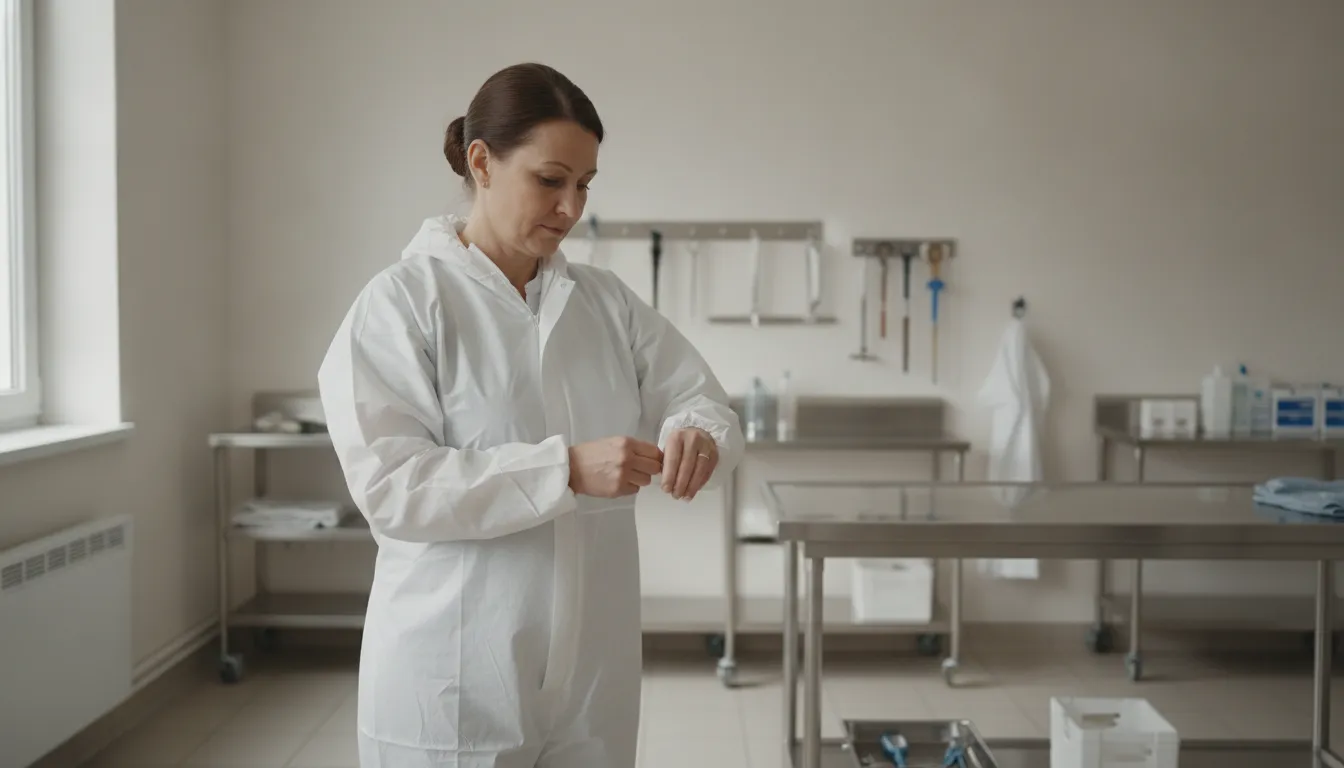
Features can matter as much as the base material. Elastic cuffs can help close the space between sleeve and glove. A hood may support coverage around the head and neck. A zipper or storm flap should be easy to operate while gloved and remain secure during movement. Boot covers may reduce exposure to footwear, but they must also support stable footing and fit the facility’s footwear policy.
No material is universally protective. A selection that works for routine dry handling may be unsuitable for a splash-prone procedure, chemical exposure, or damaged garment. Choose by task, inspect before use, and replace a torn or punctured suit.
What Do Suit Ratings and Features Actually Tell You?
Answer capsule: A garment rating describes performance under specified test conditions. It does not promise universal protection for every funeral home task. Read the label, manufacturer data, and Exposure Control Plan together. Then inspect how the suit’s construction works with the rest of the PPE ensemble.
Start with the label’s intended use and limitations. Look for the hazards the garment is designed to address, the exposure evaluated, and any referenced testing or performance classification. Do not treat the word Tyvek as a complete specification. A tyvek suit may be appropriate for one task and insufficient for another, depending on fluid contact, chemical exposure, puncture risk, heat, and underlayers.
Seams deserve attention because the fabric and the joins must work together. Review whether seams are sewn, bound, or otherwise finished. Confirm that the construction matches the exposure described in the product documentation. Check the closure while wearing gloves. An opening that is hard to operate can affect both coverage and doffing.
Hoods, cuffs, and boot covers should be evaluated with the complete ensemble. A hood must not interfere with eye protection, hearing protection, or a properly fitted respirator. Elastic cuffs can help gloves overlap the sleeve, but they do not replace correct glove selection. Boot covers should stay in place while kneeling, lifting, or moving around a cot.
Use the broader bloodborne pathogens and OSHA compliance guide to connect garment decisions with training, hygiene, and exposure-control practices. The suit is one part of a system. Gloves, eye protection, respiratory protection, footwear, work practices, and decontamination procedures also affect protection.
How Should a Funeral Home Choose the Right Size?
Answer capsule: Choose a size that allows the wearer to layer appropriately and move without pulling at seams or exposing wrists and ankles. A well-fitting tyvek suit should support safe movement through removal or preparation tasks. It should not simply feel roomy while the wearer is standing still.
Start with the clothing and equipment the employee will actually wear. If the task calls for work clothes, thermal layers, an apron, or a respirator. The suit must fit over those layers without restricting the shoulders, elbows, hips, or knees. Avoid choosing a smaller size because it looks neater in storage. Stretching across the back or seat can compromise coverage during lifting and transfers.
Run a mobility check before approving a size for routine use. The wearer should be able to reach forward, raise both arms, turn at the waist, crouch, kneel, and step around a cot or preparation table. Check whether the hood stays in place when the head turns. Confirm that it accommodates the intended face and respiratory protection without obstructing vision.
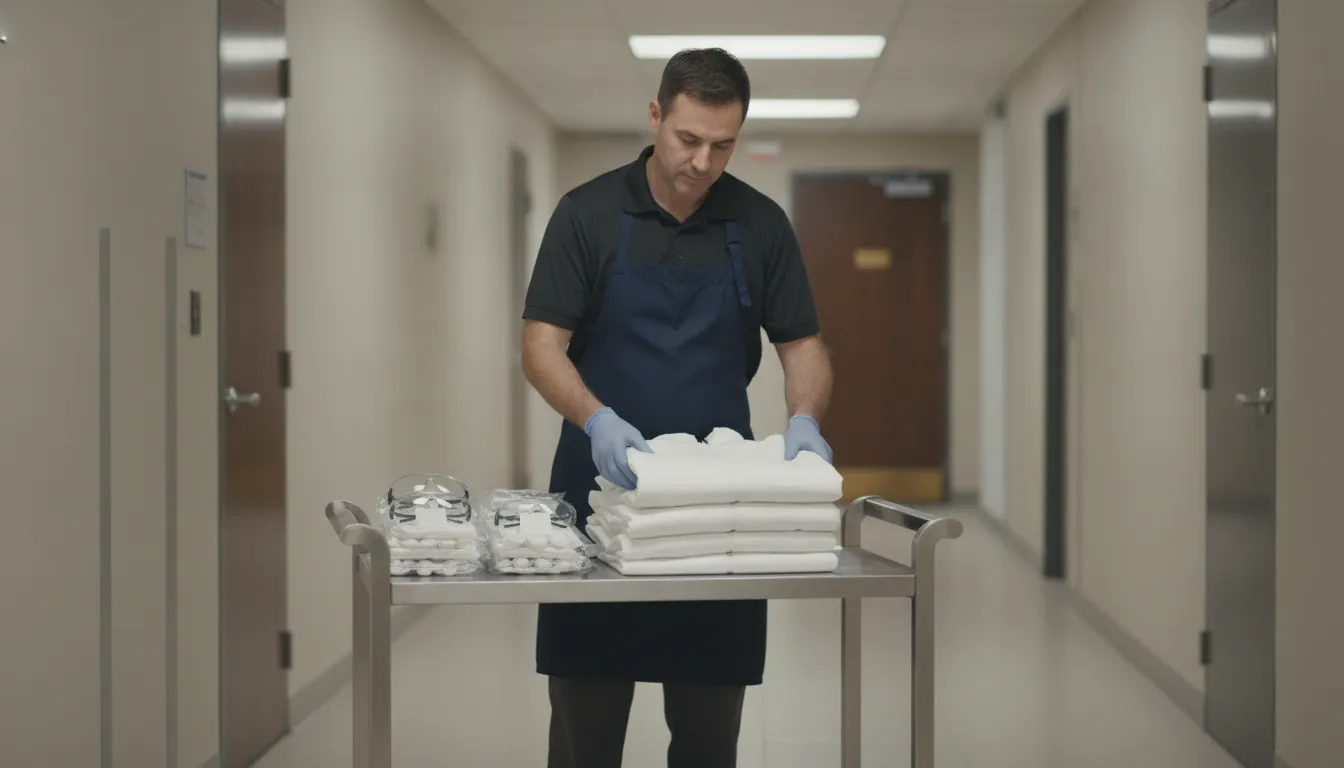
Use a team checklist, not a single try-on
- Layering: Test the suit over the heaviest clothing and task-specific PPE normally worn.
- Reach and crouching: Test lifting, reaching, kneeling, and turning. The material should not pull at movement points.
- Glove overlap: Confirm that sleeves extend far enough for gloves to overlap the cuffs.
- Hood compatibility: Check the hood, respirator, eye protection, and face protection together.
- Stock range: Keep the sizes your team needs for new hires, layered winter work, and replacements.
- Inspection: Check the zipper, elastic, hood, cuffs, seams, and fabric before use.
Record approved sizes by employee or role. Revisit the decision when tasks, layering practices, or respiratory equipment change. Fit supports the garment’s performance, but it does not replace the hazard assessment or written program.
When Should You Change a Disposable Suit?
Answer capsule: Change a disposable suit when the task changes, the garment is damaged, or contamination may have reached its outer surface. Change-out decisions should follow the exposure-control plan, not an arbitrary clock.
- Inspect before use. Check the size, seams, zipper, hood, cuffs, and any integrated boot covering. Do not use a damaged garment or package.
- Change between materially different tasks when the plan calls for it. A suit used during body removal should not automatically be carried into a clean area or separate preparation activity.
- Stop after a spill or visible contamination. Follow the facility procedure for removing the garment and selecting a replacement. Do not assume a lightweight suit is appropriate for every chemical or fluid.
- Change after a tear, puncture, failed closure, or loss of coverage. Movement and equipment edges can damage a suit. Do not patch it unless the manufacturer and facility procedure specifically permit that approach.
- Doff in the designated sequence and location. Treat the outside as potentially contaminated. Remove it slowly to avoid contacting skin or clothing.
- Use the approved waste process. Place the garment in the container or bag designated by the facility. Do not carry contaminated PPE through clean spaces.
Your facility’s procedures should identify hazards, required PPE, change-out triggers, doffing, disposal, training, and incident response. Keep replacement garments accessible near the point of use, alongside related removal equipment and supplies. A change-out plan is easier to follow when the correct size is available without leaving the work area.
How Can a Funeral Home Build a Consistent PPE Plan?
Answer capsule: A reliable PPE program assigns garments by task, keeps usable sizes available, and makes inspection, training, replenishment, and documentation part of normal operations. Consistency matters as much as the initial product choice.
Start with a task matrix. Removal work, preparation-room duties, embalming, cleanup, and incident response may involve different combinations of fluid, splash, chemical, or contamination hazards. Identify the expected exposure for each task. Then specify the suit, gloves, eye protection, respiratory protection, and other equipment required.
Train employees on inspection, donning, doffing, storage, disposal, and what to do after a tear or splash. Include practical demonstrations. A written policy is useful, but workers also need to know how the selected garment behaves when they are lifting, reaching, kneeling, or working around equipment.
Review inventory on a predictable schedule. Track sizes, garment types, unopened packages, and replacement needs. Store disposable suits in a clean, dry area where packaging stays intact. Revisit the stock plan when staffing, services, equipment, chemicals, or case conditions change.
Vischer Funeral Supplies offers a broad selection of preparation equipment and supplies for funeral homes and mortuaries. Pair product selection with your facility’s documented exposure controls. The goal is a practical system that supports worker safety, dignified service, and consistent operations.
Ready to choose the right protective apparel? Call 800-752-8767 today.
Frequently Asked Questions
Is a tyvek suit appropriate for every funeral home task?
No. Choose a suit based on the hazard assessment, garment label, documented performance, fit, and written Exposure Control Plan. A Tyvek-style suit may be useful for some tasks but may not provide the needed protection for every fluid, chemical, pathogen, or puncture hazard.
How should a funeral home compare Tyvek, SMS, and PP film suits?
Compare the exact garment’s intended use, barrier performance, seams, closures, breathability, mobility, and compatibility with other PPE. Material names are useful starting points, but they do not establish universal protection.
When should a disposable protective suit be changed?
Change the suit when the task changes according to the facility plan, the garment tears or loses coverage, visible contamination occurs, or a spill reaches the garment. Follow written doffing, disposal, and exposure-response procedures.
How can staff choose the right disposable suit size?
Choose a size that fits over required layers and allows reaching, lifting, turning, crouching, and kneeling without pulling at seams or exposing wrists and ankles. Test the hood, gloves, eye protection, and respiratory protection together.
Protective Apparel for Funeral Home Work
Review your task exposures, required features, size range, and change-out triggers before ordering. Vischer Funeral Supplies supports funeral homes, mortuaries, crematories, and forensic facilities with equipment and supply guidance grounded in practical industry use.
Contact Vischer Funeral Supplies to discuss protective apparel for your facility.