
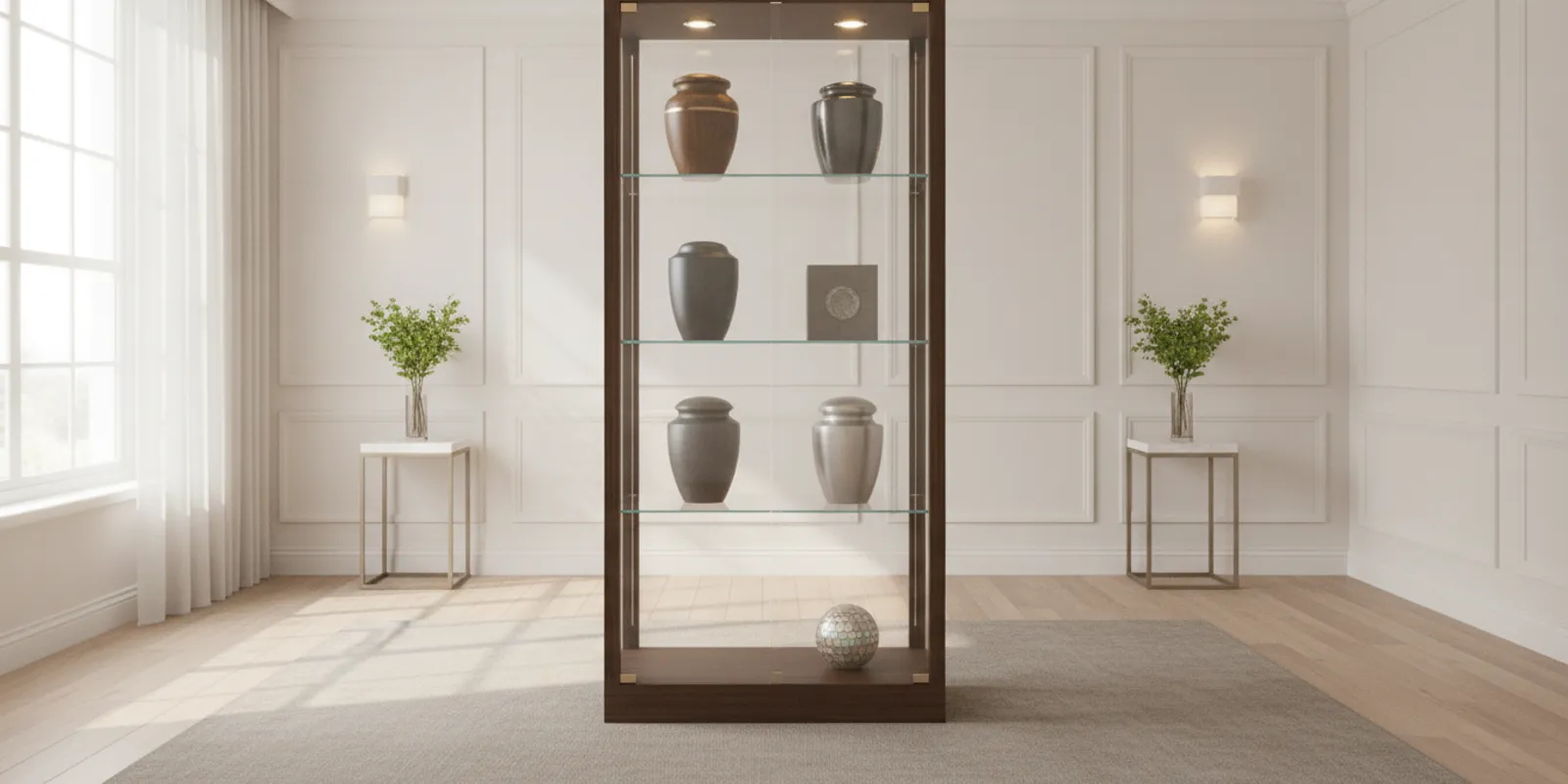
Choosing an urn display case for a funeral home means balancing presentation with practical concerns: the urns need to be visible, protected, easy to handle, and suited to the room. The right choice depends on the display’s purpose, the types of pieces shown, and how staff will maintain and update it. Use the comparisons below to set requirements before comparing products.
Discuss your urn display needs
What should a funeral home compare when choosing an urn display case?
Start with the intended use, then compare capacity, visibility, security, access, footprint, and care requirements. These factors determine whether an enclosed case is useful or whether a stable open display stand better suits the room and staff workflow.
A display is part of a family’s selection experience, not just a storage fixture. Buyers should consider how an arrangement looks from the doorway and from a seated position, how easy it is to keep orderly, and whether staff can retrieve or reposition an urn without disrupting the rest of the display.
- Purpose: Is it a permanent showroom display, a smaller selection area, or a temporary presentation?
- Capacity: How many urns will be shown at once, and what range of heights, widths, and shapes should it accommodate?
- Visibility: Can visitors see the pieces clearly from the expected viewing distance and angle?
- Protection: Does the room call for an enclosed case, or is open access more useful?
- Access and care: Can staff safely lift items, clean the surfaces, and refresh the arrangement?
- Fit: Does the footprint work with circulation, seating, lighting, and other furnishings?
Write down priorities before choosing a style. For example, a facility that needs frequent rearrangement may value quick access more than a fully enclosed presentation. A display beside a busy corridor may place greater value on protection and stable placement. Those needs can point toward different solutions, even when both are described informally as an urn display case.
Does an enclosed case or an open display stand fit the room better?
An enclosed case creates a defined presentation and can help separate displayed pieces from everyday handling. An open stand offers more direct access and flexibility. Neither format is automatically right for every funeral home; assess the room, display goals, and care routine together.
Some buyers use “case” to mean any dedicated urn display. It is useful to distinguish a cabinet with doors or glazing from an open shelf or rack before comparing products. Open display equipment can be a practical alternative when staff need to move pieces often or when the room’s style calls for a less enclosed presentation.
| Comparison point | Enclosed display case | Open stand or shelf |
|---|---|---|
| Presentation | Creates a defined, contained arrangement; glazing and interior lighting, if present, affect visibility. | Offers direct sightlines and an open presentation; the room itself becomes part of the display. |
| Access | Staff need to open the case to arrange or retrieve a piece. Check door swing and working clearance. | Pieces are directly accessible, which can simplify frequent changes but calls for an orderly placement routine. |
| Protection and care | Can provide a physical barrier; doors, glazing, shelves, and hardware add surfaces and components to clean and inspect. | Fewer enclosed surfaces may simplify access for cleaning; displayed pieces are more exposed to contact and dust. |
| Room planning | Measure the full cabinet footprint, door clearance, depth, and visual weight. | Compare footprint and stability, plus how open shelves look from different angles. |
| Best questions to resolve | Will the case fit the pieces, allow safe handling, and provide the visibility the room needs? | Will the open arrangement remain stable, intentional, and easy to maintain? |
Do not assume a product listing establishes details that are not shown, such as glazing type, locking hardware, shelf load rating, or exact interior dimensions. Confirm those specifications with the supplier before ordering. If an open approach is under consideration, compare the available heavy-duty shelf urn stand as a separate format rather than treating it as an enclosed case.
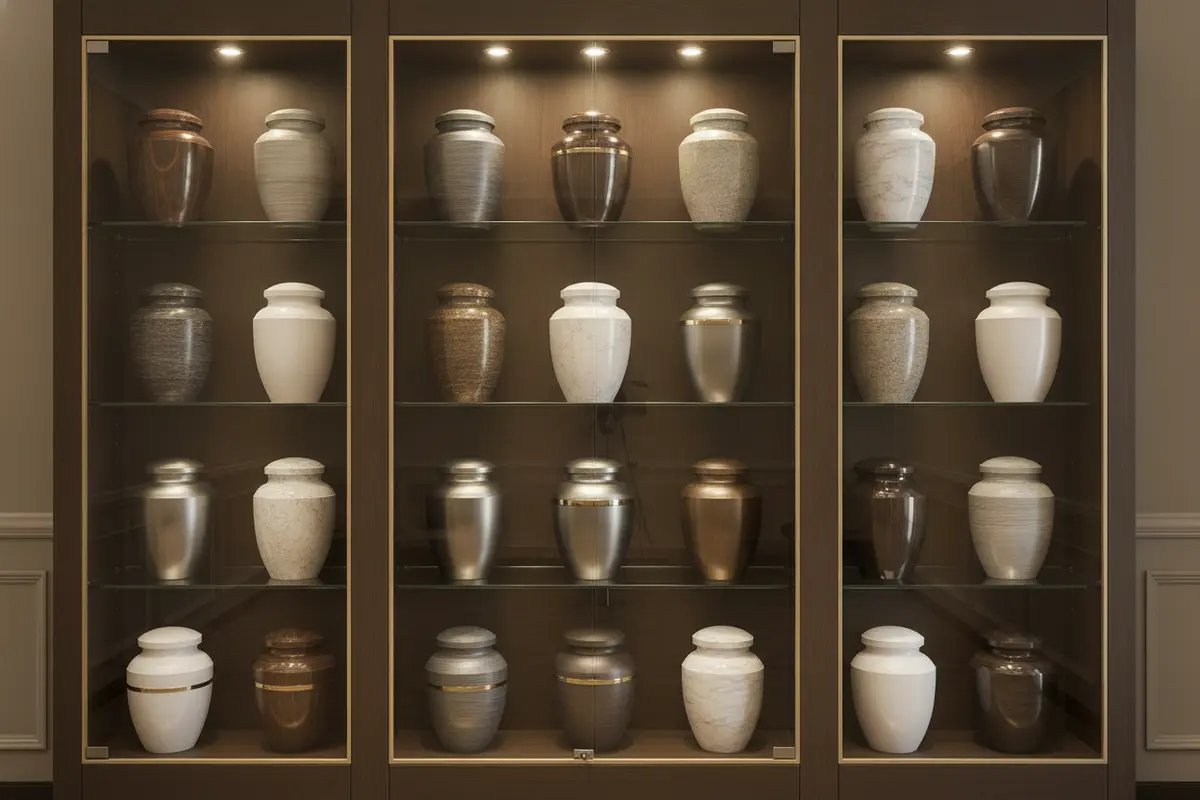
How much capacity and shelf space do you need?
Capacity should reflect the range of pieces a funeral home intends to present, not simply the number that can be squeezed into a cabinet. Measure representative urns and plan room for clear sightlines, safe handling, and a balanced arrangement.
Before shopping, make a simple inventory of the display’s intended contents. Include the largest and smallest pieces, shapes that need extra width, and any keepsakes or accessories that will share the space. If the selection changes frequently, plan for a flexible layout instead of filling every shelf to its limit.
- Measure representative pieces. Record height, width, and depth for the largest examples and any unusually shaped items. Include lids and decorative details in the measurements.
- Plan spacing around each piece. Leave room for a visitor to distinguish one option from another and for staff to grasp and lift an item.
- Account for shelves and openings. Confirm usable interior dimensions, shelf spacing, door opening, and access path. Exterior dimensions alone do not show what will fit inside.
- Allow for change. Consider whether the arrangement needs open space for new selections or seasonal changes rather than using every available position.
- Test the proposed layout. Use paper templates or mock placements at the intended scale before committing to a cabinet or stand.
Capacity is also a visual question. A case that technically holds many pieces may make them difficult to compare if shelves are crowded or sightlines overlap. Conversely, an oversized cabinet can look sparse when only a few pieces are displayed. Decide what a useful, representative arrangement looks like for your room, then evaluate dimensions against that plan.
When considering an open arrangement, the catalog includes different display formats such as ladder-shelf display options and tall adjustable display stands. Review the actual listing information and ask for any dimensions or load details you need; do not infer fit from a product name alone.
Which visibility and access details matter most?
A good display makes the pieces easy to see without making them difficult for staff to manage. Check sightlines, reflection, door movement, reach, and the work area needed to arrange or retrieve an urn.
Walk through the room as a visitor would. Look at the display from the entrance, from the usual conversation area, and from seated height if families commonly review selections while seated. Notice whether reflections from windows or overhead fixtures obscure details. If possible, assess the display with the room’s normal lighting rather than relying only on a product photograph.
For an enclosed case, ask practical questions about its access:
- Do doors open far enough to reach each shelf without awkward twisting?
- Is there sufficient clearance in front of the case when doors are open?
- Can staff lift the largest intended piece safely and place it without contacting adjacent items?
- Are shelves removable or adjustable? Confirm rather than assuming.
- Can the interior be cleaned without moving every displayed item?
For an open stand, check how the display looks from more than one angle and whether its position leaves a clear route through the room. Avoid placing a fixture where visitors or staff must squeeze past it. A stand should be evaluated for stability and intended use using manufacturer information, especially where larger or heavier items are being displayed.
Different catalog formats may support distinct room plans. For instance, 44-inch nesting display stands and 32-inch nesting display stands are options to compare when considering a compact open display. Confirm whether the format and dimensions suit the urns and purpose you have in mind.
What should you check for security, durability, and care?
Match the level of protection to the room and handling routine, then confirm how the case or stand is built and maintained. Ask about materials, hardware, stability, cleaning instructions, and any applicable weight limits before purchase.
An enclosure may create a useful barrier between displayed items and casual contact, but it does not eliminate the need for a clear care plan. Doors and shelves can collect dust; glazing can show fingerprints or reflections; hardware may need inspection. A cabinet should be easy for authorized staff to open and maintain, not merely attractive when closed.
During product review, request details that matter to your use case:
- Construction materials and finish, including care instructions.
- Interior and exterior measurements, shelf spacing, and usable shelf depth.
- Any stated shelf capacity or recommended use limitations.
- Door type, hardware, and locking options, if security is a requirement.
- Assembly, installation, delivery, and placement requirements.
- Availability of replacement parts or service information, where relevant.
Do not rely on appearance alone to judge durability or stability. Confirm product-specific information from the seller or manufacturer. Also consider the staff member who will clean and reset the display: if the design makes routine care difficult, it may not stay presentable under everyday use.
Professional funeral service organizations can provide broader industry resources. The National Funeral Directors Association is one place to find professional information; consult product documentation and applicable facility procedures for case-specific purchasing and care decisions.

How should the display fit into the room and workflow?
Plan the fixture as part of the selection room, not as an isolated piece of furniture. A successful placement supports conversation, clear movement, comfortable viewing, and staff access while keeping the display visually composed.
Measure the proposed location before comparing product dimensions. Include baseboards, nearby furniture, outlets, windows, and the full path from the delivery entrance to the final position. For a cabinet with doors, measure its operating clearance as well as its closed footprint. For a freestanding stand, consider how its placement affects circulation and whether visitors can view it without blocking another display.
Consider these workflow details:
- Visitor flow: Can people approach and view the display without crossing a staff work area or narrowing a walkway?
- Conversation: Can staff and families discuss options while facing the display comfortably?
- Reset routine: Is there room to remove, clean, and return pieces without disrupting the room?
- Lighting: Does natural or artificial light help reveal finishes, or create glare on a case front?
- Visual balance: Does the display complement nearby furnishings without competing with other focal points?
- Delivery and installation: Can the unit be moved through doors and corridors and positioned safely?
Sketch the room with measurements and mark a proposed footprint. Use a temporary outline on the floor to check circulation, or place a similarly sized object in the space for a short review. This simple exercise can reveal problems that a catalog image cannot: a door may hit a chair, a tall fixture may block a sightline, or a narrow route may make placement difficult.
Where flexibility is a priority, assess a modular or repositionable display format as well as a fixed cabinet. A ladder rack value bundle is one catalog option to review as an open display format. Confirm its intended application, dimensions, and suitability for the pieces you plan to show rather than assuming it serves as an enclosed case.
What questions should buyers ask before ordering?
A short, consistent checklist helps staff compare unlike options and identify missing details. Resolve fit, use, and product specifications before placing an order, especially when the listing does not answer a critical question.
- What is the exact intended use: long-term display, active selection, or a limited number of featured pieces?
- Which specific urn dimensions and shapes must the fixture accommodate?
- What are the usable interior dimensions, shelf spacing, and shelf depth?
- Does the product include an enclosure, doors, or a locking feature, and how are those features specified?
- What are the applicable material, care, stability, and weight details?
- How much floor space and door clearance are needed in the chosen location?
- What assembly, delivery, and installation steps should the facility plan for?
- What information is not available on the listing and needs direct confirmation?
Keep responses with the purchasing record so future staff know why the fixture was selected and what constraints apply. If two products seem similar, compare the same criteria for each instead of relying on names or photographs. The heavy-duty shelf display option can be reviewed alongside other open formats when the facility is deciding whether an enclosed case is necessary.
How can a team evaluate the final choice?
Before ordering, compare the proposed fixture against the room plan and a representative set of urn measurements. Confirm all critical specifications with the supplier, then document a simple arrangement and care routine for staff.
A useful final review has three parts. First, confirm that the fixture physically accommodates the pieces and can be moved into position. Second, verify that it supports the desired viewing experience from the room’s normal visitor positions. Third, ensure staff can access, clean, and reset it using a manageable routine.
Use a simple scoring sheet if multiple options are under review. Rate each item against the facility’s own priorities, such as capacity, visibility, access, footprint, protection, care, and verified product details. Decide in advance which requirements are essential and which are preferences. A product that scores well overall may still be unsuitable if it fails a must-have dimension or access requirement.
Once selected, place the fixture where it can be viewed and approached easily. Arrange pieces with enough spacing to distinguish their profiles and finishes. Review the display periodically for dust, fingerprints, shifted items, and changes in room lighting or visitor flow. The goal is not a crowded catalog of every option, but a calm, legible presentation that staff can maintain.
Frequently asked questions
Is an urn display case better than an open stand?
Neither format is best for every room. An enclosed case creates a defined presentation and a physical barrier, while an open stand allows direct access and flexibility. Compare room conditions, handling, care, and visibility needs.
What measurements should I take before buying an urn display case?
Measure the largest and most unusual urns, the proposed floor location, and the route to that location. Confirm usable interior dimensions, shelf spacing, shelf depth, door clearance, and access space with the supplier.
Should an urn display case have a lock?
That depends on the facility’s room and handling requirements. If a lock is needed, verify that the specific product includes suitable locking hardware and confirm how staff will access and maintain the display.
How can we keep an urn display presentable?
Follow the fixture and urn care instructions, check routinely for dust or fingerprints, keep pieces spaced and aligned, and make sure staff can safely access the shelves for cleaning and rearrangement.
Choosing an urn display case is a matter of fit: the fixture should suit the pieces, room, and daily routine. Compare verified specifications and test the layout before making the final selection.