

A removal cot cover is a practical part of a transfer setup, but the right choice depends on the cot, the work being done, and how the team will handle and care for the cover. A deliberate selection process helps funeral home, mortuary, crematory, and forensic teams check fit, coverage, handling, and replacement needs without assuming that one cover works for every cot or situation.
Ask about removal cot cover options
What should a removal cot cover do?
A cot cover should suit the equipment and workflow it is used with. Treat it as one part of an organized transfer setup, not as a substitute for cot inspection, careful handling, or the facility’s established procedures.
Start with the task the team needs the cover to support. Are staff looking for a fitted cover for a removal cot, a cover supplied as part of a set, or a separate barrier that their facility already specifies? These are not automatically interchangeable. A cover’s name or appearance alone does not confirm its intended use, fit, material, or care instructions.
Before ordering or assigning a cover, establish a few basics:
- Which cot is it for? Record the manufacturer and model where available, plus any measurements needed to verify fit.
- What coverage is expected? Identify the surfaces the cover needs to protect in the intended workflow.
- How will staff handle it? Consider how it is put on, removed, stored, and sent for care or replacement.
- Who confirms the choice? Assign a person to check specifications and approve a new item before it enters routine use.
Vischer’s catalog includes Final Embrace cot covers and sets. Confirm the current product description and fit information before choosing a specific item. The available catalog listing is a starting point for evaluation, not proof that a product fits every model or meets every facility’s procedures.
How do you confirm fit and coverage?
Confirm fit against the actual cot and the product’s documented dimensions or compatibility information. Do not rely on a generic description, a visual resemblance, or an assumption that covers are universal.
Begin by identifying the cot used by the team. If a label or equipment record is available, note the manufacturer and model. Then compare the cover’s stated dimensions and intended application with the cot. If the description does not answer a key question, pause and request clarification from the supplier or manufacturer rather than guessing.
- Measure consistently. Follow the cover maker’s instructions for measuring. Record the cot’s relevant length, width, and any other dimensions the instructions call for.
- Check the shape and attachment. Determine whether the cot has features, handles, rails, or moving parts that affect how a cover sits. Do not assume an opening or fastening method is compatible.
- Assess coverage in the intended setup. Consider whether the selected cover stays in place during normal handling and whether it obstructs access to cot controls or safe movement.
- Verify before routine use. When a new cover arrives, inspect it and check its fit on the intended equipment before assigning it to a transfer workflow.
- Document the match. Keep the cot identification, selected cover, and any supplier confirmation together so staff can reorder consistently.
Fit is not simply a question of whether fabric reaches around the cot. A cover that bunches, slips, or interferes with handling may not be suitable for the task. Conversely, a cover that looks close to the cot’s dimensions should not be presumed compatible without checking the maker’s guidance.
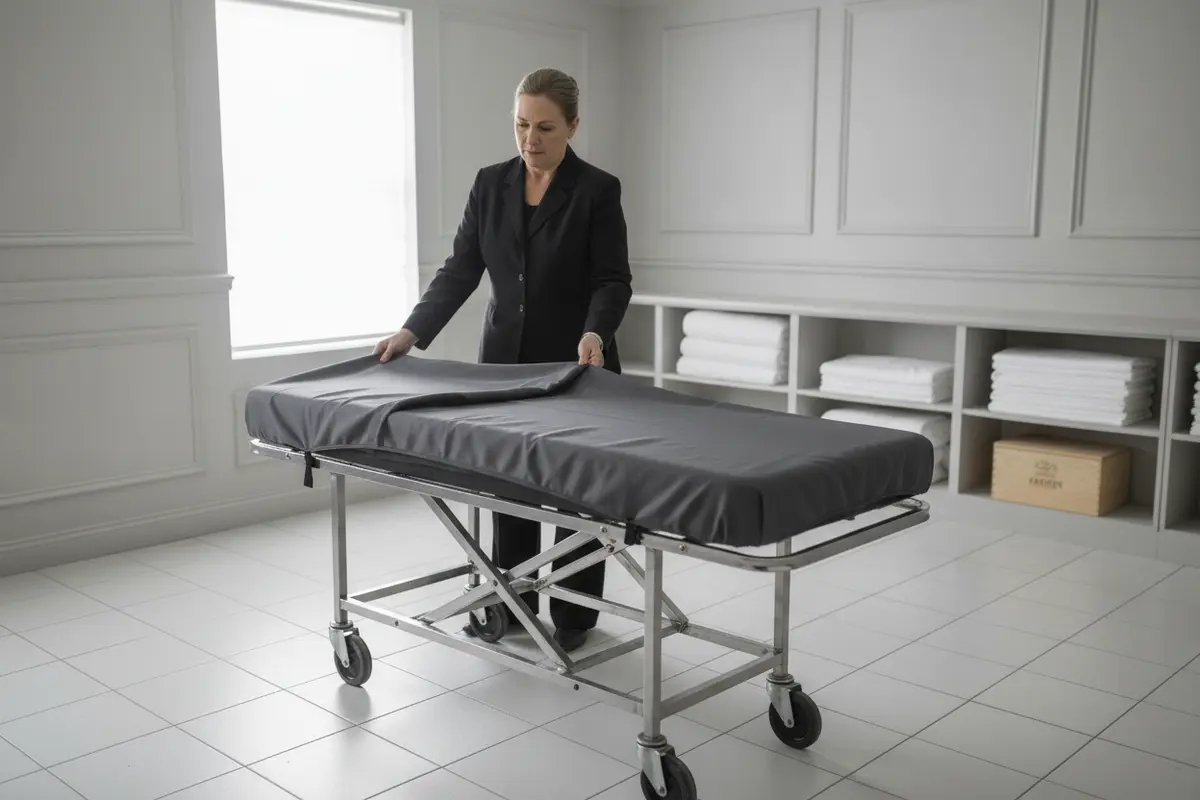
Which cover approach fits your workflow?
The best approach is the one that matches the equipment, the intended task, and the facility’s care procedures. Use the comparison below to frame questions; it does not replace the product’s own specifications or local policy.
| Approach to assess | Useful when considering | What to verify |
|---|---|---|
| Fitted removal cot cover | A cover intended to be used with a particular cot or cot family | Stated dimensions or compatibility, coverage, attachment, and care instructions |
| Cot cover set | The team is evaluating a listed set rather than a single component | Exactly what the set contains, whether each component suits the workflow, and whether fit is specified |
| Separate barrier or protective layer | A facility’s written process calls for an additional layer or a different protective product | Whether the item is intended for that use and how it interacts with the cot cover and established procedure |
These categories describe questions to ask, not interchangeable product classes or promises about a particular item. A separate barrier may have different handling and disposal instructions from a reusable cover. Follow the relevant product information and facility procedure. If a team uses other transfer equipment, such as a flexible stretcher, assess that equipment on its own terms; a cot cover should not be presumed suitable for it.
How should teams use and care for a cot cover?
A clear routine helps staff handle the cover consistently and identify problems early. Write the routine around the maker’s care instructions and the facility’s established procedures, then make it easy for the people doing the work to follow.
Before use, staff can check that the correct cover is available, appears intact, and is assigned to the intended cot. During use, follow the facility’s transfer workflow and avoid placing the cover in a way that obstructs movement or access to equipment. After use, handle the cover according to its instructions and the facility’s process. Do not invent a washing method, disinfectant, temperature, or reuse limit when the product documentation does not specify one.
A practical written workflow can answer these questions:
- Where are clean, ready-to-use covers stored?
- How are used covers separated from clean supplies?
- Who follows the manufacturer’s care instructions and records completion when required?
- Where are covers placed if they are wet, damaged, or awaiting review?
- Who decides whether an item is returned to use or replaced?
These decisions should fit the product’s stated care requirements. If staff are uncertain whether a cover can be cleaned, reused, repaired, or paired with another layer, take it out of the normal rotation until the responsible person confirms the correct next step. A consistent routine is especially valuable when several people share equipment or when a cot and its accessories move between rooms.
Turn those questions into a sequence people can follow at the point of use. For example, the assigned staff member can first identify the cot and its approved cover, then check the cover’s visible condition and placement. After the transfer, staff can follow the designated process for separating used items, recording any concern, and returning only reviewed equipment to the ready area. The sequence should say where a cover goes if its status is unclear; otherwise, a questionable item may be mistaken for ready stock during a busy shift.
Keep the routine specific without adding unsupported technical instructions. A short local checklist can refer staff to the exact product care sheet, identify the responsible role, and explain how to report a damaged or unidentifiable cover. If instructions change after a product replacement, update the checklist and remove superseded copies. This helps prevent one person’s assumptions about an older cover from becoming an informal rule for a different product.
Transfer planning also involves communication and coordination. The Ohio Funeral Directors Association’s published recommendations on facilitating transfers from care facilities address preparation for transfer. Use applicable facility and jurisdictional procedures for the situation; the document is not a cot-cover specification or a substitute for product instructions.

What should you inspect, store, and replace?
Routine checks help a team notice visible damage, missing items, or storage problems before a cover is needed. Inspection does not establish hidden material performance; use product documentation and the responsible person’s judgment for questions beyond a visual check.
Include cot covers in the facility’s normal equipment review. The checklist can be short, provided it identifies what staff should look for and who handles a concern:
- Condition: Look for visible tears, holes, broken closures, separated seams, or other changes that could affect use.
- Cleanliness and readiness: Confirm the item is stored in the state required by facility procedures and product instructions.
- Identification: Check that the cover can be matched to the intended cot or the documented use.
- Completeness: For a set, check its listed contents rather than assuming all components remain together.
- Action: Record concerns and route questionable items to the designated reviewer instead of returning them automatically to the ready supply.
Store covers in a designated area that supports separation of clean and used items under the facility’s process. Keep the manufacturer’s instructions accessible to the staff responsible for care. Avoid stacking unrelated equipment in a way that hides damage or makes a selected cover difficult to identify. If staff also use adjustable body straps or body positioners, list and inspect those items separately. Their presence in the same work area does not establish that they are part of a cover set or compatible with a particular cot.
Replace or remove a cover from the ready supply when it is visibly damaged, cannot be cared for as instructed, cannot be identified for its intended use, or otherwise fails the facility’s review. Follow the supplier’s or maker’s guidance when the concern is not obvious. Record the reason for removal and the replacement decision so the next person understands the equipment status.
A simple status method can make this review more reliable. Decide where items awaiting review will be kept and how staff will distinguish them from ready-to-use supplies, using the facility’s existing labeling and storage practices. The record need not be complicated: note the date, the concern, the person or role notified, and the decision once it is made. If a cover is part of a set, note whether the concern applies to one component or affects the whole set, and check the product information before returning any part to service.
What should buyers check before ordering?
A short purchasing review can prevent mismatched orders and clarify what staff should expect on delivery. Collect the equipment and workflow details first, then compare them with the product information and request answers to unresolved questions.
- Identify the equipment. Share the cot make and model, plus measurements if requested.
- Describe the intended use. Explain what coverage the team needs and whether it is considering a single cover or a set.
- Ask for product specifics. Confirm dimensions, fit guidance, included components, care instructions, and any limits stated by the maker.
- Check the quantity. Estimate how many covers the workflow needs to keep the cot available while items are being handled according to instructions.
- Review delivery and replenishment. Confirm current availability and lead time with the supplier instead of assuming they are fixed.
- Assign the receiving check. Decide who will compare the delivered item with the order and verify it before routine use.
The catalog also includes a broader preparation supplies category for teams reviewing related room and workflow needs. Keep the purchase focused: a cot cover question is different from choosing a stretcher, a casket table, or a first-call cover. For example, a Ferno Model 321 First Call Cover is listed as a distinct product. Do not treat its listing as confirmation that it is designed for a removal cot.
For a new product or an unclear fit, provide the supplier with the cot identification and the precise question. Ask for written clarification when compatibility, care, or set contents are not clear in the listing. Retaining that answer with the purchasing record makes future reorders easier and gives the receiving staff a reliable reference.
Before placing the order, have the person who will receive the cover review the same details. Confirm the ordered description, quantity, and any stated components against the request. On arrival, compare the item and its documentation with that record; do not place it into routine rotation just because the package or product name appears familiar. If the cover differs from the expected description, or the paperwork leaves fit or care unresolved, pause and direct the question to the designated buyer or supplier contact.
For teams with more than one cot, keep a short mapping rather than relying on memory. A row for each cot can identify its make and model, the approved cover reference, and the location of its care instructions. This lets a buyer see whether a proposed replacement is for one particular setup or part of a broader standardization effort. It also makes a useful distinction between an item that has been considered and one whose compatibility has actually been confirmed.
How can a team make the choice repeatable?
Record the approved cover and the cot it belongs with, then give staff a simple inspection and care routine. A repeatable system reduces guesswork when equipment is shared, reordered, or handled by different team members.
A one-page equipment record can include:
- Cot make, model, and identifying label;
- Cover name and supplier reference;
- Fit or compatibility information confirmed by the maker or supplier;
- Care and storage instructions, with the location of the full documentation;
- The person or role responsible for checks, receiving, and replacement decisions; and
- The date of the most recent review, along with any open questions.
Review the record when a cot is replaced, a cover changes, or the facility changes its procedure. If the team’s equipment includes other transport or positioning products, such as a Ferno adjustable casket table, maintain separate fit and care notes for each item. Clear distinctions help prevent an accessory for one piece of equipment from being assumed suitable for another.
Use a small trial and review step when introducing a new cover. First, assign the receiving check to someone familiar with the cot and ask that person to verify the supplied item against the order and the maker’s information. Next, walk through the normal setup and handling sequence in the work area, without substituting a test for any facility-required review. Note practical questions such as whether staff can identify the correct cover, where it is stored, and how used items are routed under existing procedures.
Then close the loop: record unresolved fit or care questions, obtain clarification, and update the equipment record before making the cover part of the standard workflow. If the team uses several cots or locations, repeat the check for each relevant combination rather than assuming that one successful match applies everywhere. When a replacement is ordered later, compare it with the approved record and review any changed product information. This modest process helps keep purchasing, receiving, and daily handling aligned without turning a simple accessory decision into an undocumented assumption.
Frequently asked questions
These answers provide a starting point for selection and planning. The product’s current instructions and the facility’s established procedures govern specific use and care.
Are removal cot covers universal?
Do not assume they are. Check the stated dimensions or compatibility information against the cot’s make and model, and ask the supplier or manufacturer when the listing is unclear.
Can a cot cover be used on a flexible stretcher?
Only if the product information confirms that intended use. A cot and a flexible stretcher are different equipment; assess the fit and directions for each rather than transferring assumptions from one to the other.
How often should a removal cot cover be replaced?
Follow the manufacturer’s instructions and the facility’s review process. Remove an item from the ready supply when it is damaged or otherwise fails inspection, and ask the responsible person to determine whether it can be returned to use.
Can a cover be cleaned or reused?
That depends on the product’s care instructions. Do not infer a cleaning method or reuse limit from appearance alone; consult the documentation and follow facility procedures.
Contact Vischer about removal cot covers
Build the decision into your equipment plan
Choose a removal cot cover by confirming the cot, intended coverage, fit information, care instructions, and the team’s handling routine. Keep those details with the equipment record, inspect covers as part of normal checks, and seek clarification before using any item whose fit or care requirements are uncertain.