

Choosing funeral home safety supplies is not just a matter of keeping boxes of gloves on hand. A useful supply plan starts with the tasks staff perform, the hazards they may encounter, and the steps that make protective equipment available, usable, and ready for replacement. This guide offers a practical way to organize those decisions across preparation, transfer, cleaning, and other routine work.
Ask about safety supplies for your facility
What should a funeral home safety supply plan cover?
A safety supply plan connects products to real work activities instead of treating every item as interchangeable. Start by listing tasks, identifying likely exposures or handling concerns, and noting what staff need before, during, and after each task.
Use the plan to answer four operational questions: What supplies are needed? Where will staff find them? Who checks stock and condition? What happens when an item is missing, damaged, or unsuitable? A concise written answer to each question makes day-to-day expectations easier to follow and review.
Build the list around the work areas and procedures at your own facility. A funeral home, crematory, mortuary, and forensic department may have different activities and equipment, even when they share some basic supplies. Do not assume that one standard kit covers every situation.
- Task: Describe the activity, such as preparation-room work, moving equipment, or handling a sharp.
- Hazard: Identify the exposure or physical concern relevant to the procedure. Use the facility’s hazard assessment and applicable product information rather than guessing.
- Supply: Match the item to the task and its instructions for use.
- Workflow: Decide where it is stored, how it is put on and removed, and how it is disposed of or cleaned.
- Review: Set a person and interval for checking quantities, packaging, and condition.
This guide is about selecting and managing everyday safety supplies. It is not a substitute for a site-specific hazard assessment, staff training, product directions, or applicable workplace requirements. When a question depends on a chemical, device, or regulation, verify it against authoritative documentation and your facility’s procedures.
A useful first pass is to walk the work areas with the people who perform each task. Ask them to show where they retrieve supplies, where used items go, and what happens when a needed size or product is not there. A written inventory may list every item in storage but still miss a workflow problem, such as a disposal container placed beyond the point of use or protective items stored in a room staff cannot access during a task.
Record routine tasks separately from unusual or occasional work. For example, an item used during a daily procedure may need a clearly assigned storage point and reorder level, while a less frequent task may call for a separate pre-task confirmation. This distinction helps avoid both a cluttered, oversized supply list and a plan that overlooks important but infrequent needs.
How do you match supplies to the work?
Match each supply to a defined task and a stated need. The right choice depends on what staff will do, what contact or exposure is possible, how long the task lasts, and whether the item works with other equipment in the procedure.
For each recurring task, walk through the sequence from setup to cleanup. Consider hand protection, eye or clothing protection when called for by the hazard assessment, hand hygiene, waste handling, and any supporting items required by the procedure. Keep chemical-specific decisions tied to the product label, safety data sheet, and the facility’s written controls. A general-purpose item should not be assumed to protect against every hazard.
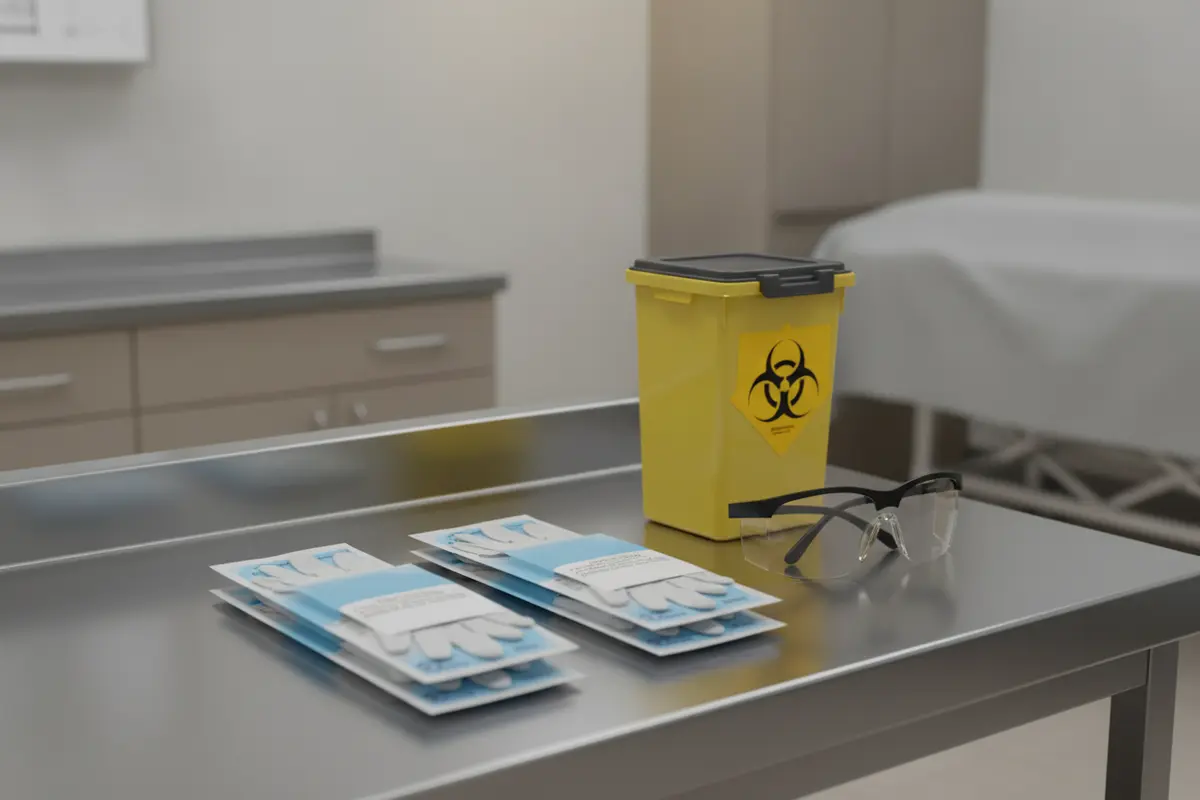
Gloves illustrate why the task matters. A glove should fit the worker and be appropriate for the material and activity. Consider dexterity, comfort over the expected work period, and whether the glove can be changed at the right point in the procedure. Vischer carries glove options from brands including MicroFlex and Shamrock Manufacturing, as well as specific options such as X-Large blue nitrile exam gloves. Check the product description and directions to determine whether a particular glove fits the intended use.
Include the supporting supplies that help the procedure stay orderly. A sharps container belongs in a plan for tasks that generate sharps waste, with location and replacement arrangements decided in advance. Preparation-room operations may also require a broader range of preparation supplies and equipment. The exact combination will depend on the facility’s work and written procedures.
Make the task-to-supply connection explicit in the checklist. Rather than writing only “gloves,” name the work area or activity, the accepted product description or specification, and the sizes that need to be accessible. The same approach applies to supporting supplies: indicate which procedure requires a sharps container, where it is staged, and who confirms it is ready. These details reduce the chance that a staff member must make a rushed selection from several unrelated products.
Then test the proposed setup against a real workflow. Have a team member follow the written sequence using the supplies in their assigned locations. Note whether they can reach items without interrupting the task, whether the packaging is easy to distinguish, and whether the disposal or cleanup steps are clear. A brief walkthrough can reveal practical gaps before the checklist becomes routine.
Which safety supplies belong in a task-based checklist?
A useful checklist groups supplies by function and task rather than by brand. It should help staff quickly locate what they need and help the person replenishing stock see what is low or due for review.
| Supply group | Planning question | Routine check |
|---|---|---|
| Hand protection | Does the selected glove suit the task, fit the user, and allow required movement? | Confirm sizes are available, packages are intact, and the product is appropriate for the planned use. |
| Eye or clothing protection | Does the hazard assessment or procedure call for additional protection? | Check condition, fit, compatibility with other equipment, and the manufacturer’s use instructions. |
| Sharps disposal | Will the task generate sharps that require a dedicated disposal container? | Confirm the container is accessible, secure, and managed under facility procedures. |
| Cleaning and hand hygiene support | What does the procedure require before and after the task? | Check supplies, product directions, and the separation of clean and used items. |
| Storage and handling | Can staff reach supplies without crossing a work area or interrupting a task? | Keep stock organized, protected from damage, and clearly assigned for replenishment. |
Use the table as a starting point, not a universal compliance checklist. Add the products and checks called for by your facility’s own procedures. If staff handle a substance or use a device with specific protection instructions, record where those directions can be found and who is responsible for reviewing them.
Give each checklist item an owner and a useful status rather than relying on a vague tick mark. For instance, a check could record “in stock,” “reorder,” “damaged—remove from service,” or “confirm product information.” If something needs follow-up, add who will address it and when. This makes the checklist useful to the next person who opens the cabinet, not just a record that someone looked at it.
Consider keeping a short task card near a work area when staff need a quick reminder of the supplies to stage. The card should point back to current facility procedures and product directions, not replace them. Keep it simple enough to update when the selected product or workflow changes, and remove outdated copies so staff are not left comparing conflicting instructions.
How can you make supplies accessible without overstocking?
Supplies are useful only when staff can find the right item in usable condition. Set a consistent home for frequently used products, and keep task-specific items close to the work area where they are needed, subject to safe storage requirements and manufacturer guidance.
Separate unopened stock from supplies staged for a procedure. Keep different sizes or types easy to distinguish, and avoid placing products where they may be crushed, contaminated, exposed to unsuitable conditions, or confused with used items. Follow product storage directions; do not rely on appearance alone to decide whether an item is still suitable.
A simple replenishment system can prevent last-minute searches. Choose a minimum quantity for frequently used supplies based on actual use and the time required to reorder. When stock reaches that level, assign a person to replenish it. For less frequently used items, schedule a periodic check so their location, condition, and availability do not go unnoticed.
- Choose a storage location for each supply category.
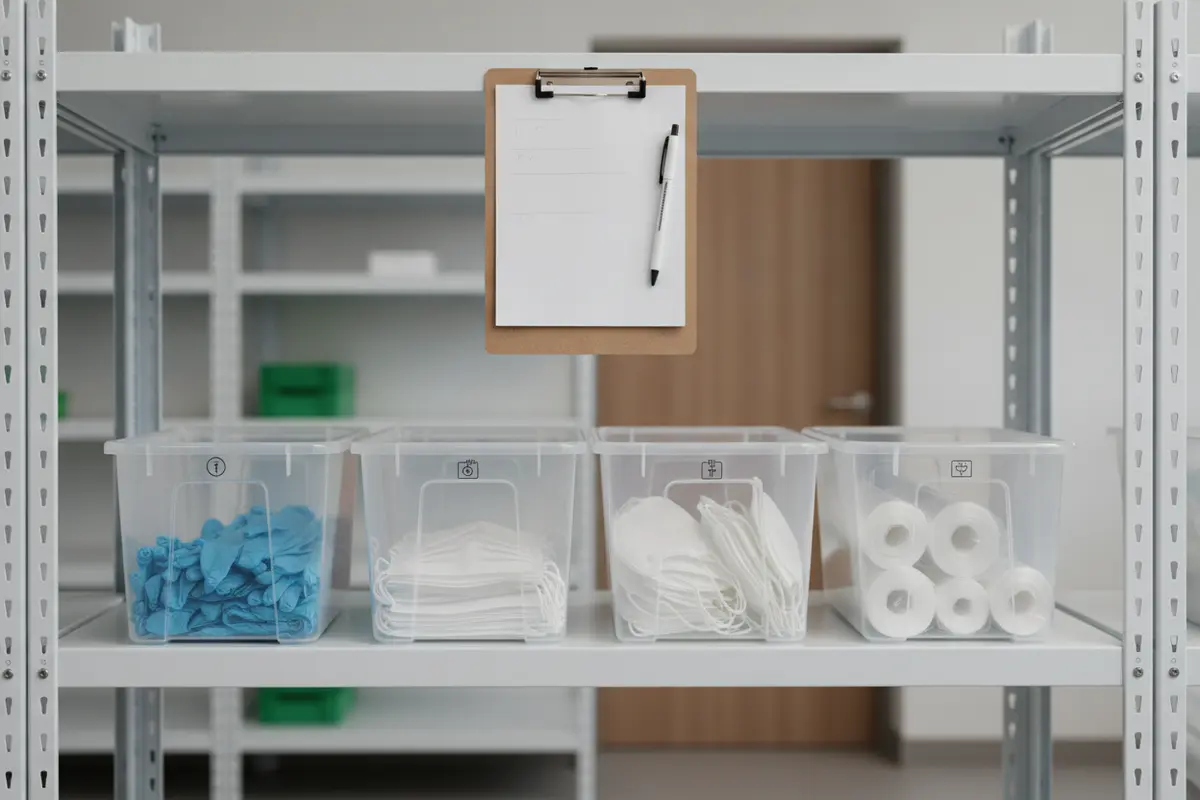
- Label shelves or bins in plain language that matches staff procedures.
- Set a reorder point for items used regularly.
- Record low stock, damaged packaging, or questions about suitability.
- Review the arrangement after a change in task, product, or room layout.
Do not stock a product merely because it appears on a generic list. Unneeded variety can make selection less clear, while too little choice may leave staff without an appropriate fit. Use purchasing records and staff feedback to identify frequently used sizes and items, then review those choices against the tasks and product instructions.
Set reorder points from the way the facility actually uses an item. If a particular glove size is used in several work areas, a count from only one cabinet will not show the full demand. A straightforward method is to check usage and ordering intervals over several routine cycles, note when an item approaches shortage, and set a minimum that gives the assigned buyer time to replenish it. Adjust the level if orders regularly arrive before stock runs low or if staff repeatedly find empty locations.
For a multi-room facility, decide whether frequently used supplies belong at a central store, at points of use, or in both places. A central stock area can simplify inventory, while modest amounts at the work area may reduce unnecessary trips. Whatever the arrangement, name the person responsible for transferring replenishment stock and checking the local supply point. Avoid moving products into unmarked containers if doing so could obscure product identity, directions, or storage information.
Make the system easy to maintain during busy periods. Use a consistent visual order, keep a small inventory sheet or electronic record in a known place, and provide a clear way to report a shortage between scheduled checks. When staff can flag a low item as soon as they notice it, the next check is less likely to uncover an urgent gap.
What should staff check before and after a task?
A short pre-task check helps staff confirm that the expected supplies are ready and that the procedure still matches the conditions in front of them. A closing check supports proper handling of used items, restoration of the work area, and replenishment for the next task.
Before beginning, staff can verify that the correct supplies are present, packages are intact, products fit the intended purpose, and supporting disposal or cleaning items are accessible. They should pause and follow the facility’s escalation procedure if a required product is missing, damaged, or not clearly suitable. Substituting an unverified product can create uncertainty rather than resolve it.
At the end of the task, follow the applicable written procedure and product instructions for removing, disposing of, or cleaning items. Replenish staged stock, return unopened items to their assigned location, and report any supply gap or unexpected condition. Never treat a quick visual check as a replacement for a manufacturer’s use or inspection instructions.
A practical pre-task check can be brief while still being specific. Confirm the task and current procedure; gather the listed supplies; check the product identity, size, packaging, and condition; and make sure the expected disposal or cleaning items are present. If any part of the setup differs from the plan, stop long enough to follow the facility’s process for resolving the issue. This is especially important when a substitute product has not been reviewed for the intended use.
At closeout, staff can work through the reverse sequence: handle or dispose of used items as directed, clean or return reusable equipment only as the procedure allows, separate unopened supplies from anything used, and leave the work area ready for the next task. Report an item that ran out, a damaged package, or a missing size promptly. A short handoff note prevents the next shift from discovering the gap only when the supply is needed.
Review official workplace guidance when your facility needs to confirm its responsibilities. The Occupational Safety and Health Administration (OSHA) provides resources for employers and workers. Requirements can depend on the activity, hazard, and jurisdiction, so use current authoritative materials and qualified guidance to evaluate your specific program rather than relying on a generic product list.
How should you evaluate products and suppliers?
Compare products on suitability, usability, instructions, availability, and the information staff need to make a clear choice. A low unit price alone does not establish that an item fits your procedure, while a familiar brand alone does not answer every task-specific question.
Before placing an order, confirm the product name and specification, available sizes or configurations, and any compatibility considerations. Ask whether the information needed for staff training and safe use is available. For supplies used routinely, consider whether you can keep the selected option consistent enough for staff to recognize it and manage replenishment. Compare the available product information and sizing rather than assuming that two gloves with similar descriptions are interchangeable. Vischer lists X-Large latex exam gloves and medium black nitrile gloves; check the material, size, and intended use against the task and product details before choosing.
For equipment and consumable needs that intersect with preparation work, review relevant catalog categories, including medical products for funeral homes and mortuaries. Product pages can help identify available options, but staff should still confirm suitability against their procedure and the manufacturer’s documentation.
Keep purchasing decisions connected to the people who perform the work. Ask staff whether a glove size is available when needed, whether labels are understandable, and whether supply placement interrupts the workflow. Capture the response, make a specific adjustment, and check whether it solved the problem. This practical feedback can expose gaps that a purchasing spreadsheet alone may miss.
Use a consistent comparison when reviewing alternatives. First, write down the task and the features the procedure requires. Next, compare product descriptions, sizes, directions, and any relevant compatibility information. Then consider whether staff can identify and use the option consistently, and whether the facility can keep it available at the required locations. Finally, record why the choice was made and what would trigger another review, such as a changed procedure or product specification.
Before changing a routinely used supply, plan a controlled handoff. Update the task list and storage label, make sure the new product information is accessible, and tell the affected staff what changed. Remove or clearly segregate old stock according to facility policy so the former and replacement items are not casually mixed. A small, documented transition is easier to manage than an unannounced substitution made during a busy shift.
How should you document routine supply checks?
A brief record turns a supply check into a repeatable handoff. It does not need to duplicate every product instruction; it should show what was checked, what needs attention, and who will follow up.
For commonly used items, a simple log can include the date, supply location, item or category reviewed, and any action taken. Staff might note that a size needs replenishing, packaging is damaged, or product information needs review. Keep the record in the place your team uses for operational checks, while following your facility’s documentation and privacy practices.
Make responsibility explicit. One person may perform routine checks, while a manager handles questions about substitutions or updates to procedures. If a staff member finds an unsuitable or missing item during a task, they should know whom to notify and what the facility expects them to do before proceeding. This prevents an informal workaround from quietly becoming the new routine.
Review the log for patterns rather than treating each entry as isolated. Repeated shortages can point to an unrealistic reorder point or a storage location that is hard to access. Repeated uncertainty about a product can prompt a review of labeling, purchasing choices, or staff instructions. Close the loop by recording the adjustment and checking whether the same issue recurs.
Keep entries concise and operational. A useful note identifies the affected location and item, describes the issue without speculation, and states the next step. For example, “preparation-room glove bin: medium size low; reorder assigned to supply lead” gives a clear handoff. If the concern is product suitability rather than quantity, route it to the person authorized to review the procedure instead of treating the log as approval to substitute.
Choose a review interval that reflects how often items are used and how quickly a shortage could interrupt work. High-use supplies may need checks more often than occasional items. The interval can be adjusted when staff report repeated stockouts or when usage changes, but make the updated schedule clear so responsibility does not become ambiguous.
How can a facility keep the plan current?
Revisit the supply plan when work changes, not only during an annual inventory. A new product, revised task, room change, equipment replacement, or repeated stockout can affect which items staff need and where they should be kept.
Keep a short record of the plan’s owner, review date, selected products, and unresolved questions. This helps staff distinguish an approved routine from an improvised substitution. It also gives a manager a clear starting point when reviewing supply use or preparing for a change.
Use staff feedback and the facility’s incident or near-miss reporting process to identify recurring issues. For example, repeated shortages may indicate that the reorder point is too low, while repeated questions about product choice may signal unclear labeling or instructions. Make one clear adjustment, communicate it to affected staff, and verify that the new arrangement works.
Keep the plan proportionate. A compact, task-based checklist that people actually use is more practical than a long inventory that no one can maintain. The goal is to make suitable supplies easy to identify, find, use according to their directions, and replenish as part of the work routine.
A review should also check whether the written plan still matches the supplies on the shelf. Confirm that product names and specifications are current, storage points remain practical, and staff know how to raise a question. If a task or room layout changed, walk through the updated sequence rather than editing a checklist from memory. Document a new responsible owner or review date whenever staffing or operating arrangements change.
When a facility identifies a mismatch, separate immediate correction from longer-term prevention. Replace or replenish what is needed under the facility’s procedure, then ask why the gap occurred: Was the stock level unrealistic, was the item stored elsewhere, or did staff not know how to report a shortage? Addressing the cause helps keep the same issue from returning with the next task.
Discuss your facility’s supply needs
Funeral home safety supplies work best when they are selected for defined tasks and supported by clear storage, use, and replenishment routines. Review the plan with the people who use it, and update it whenever your work or the products involved change.