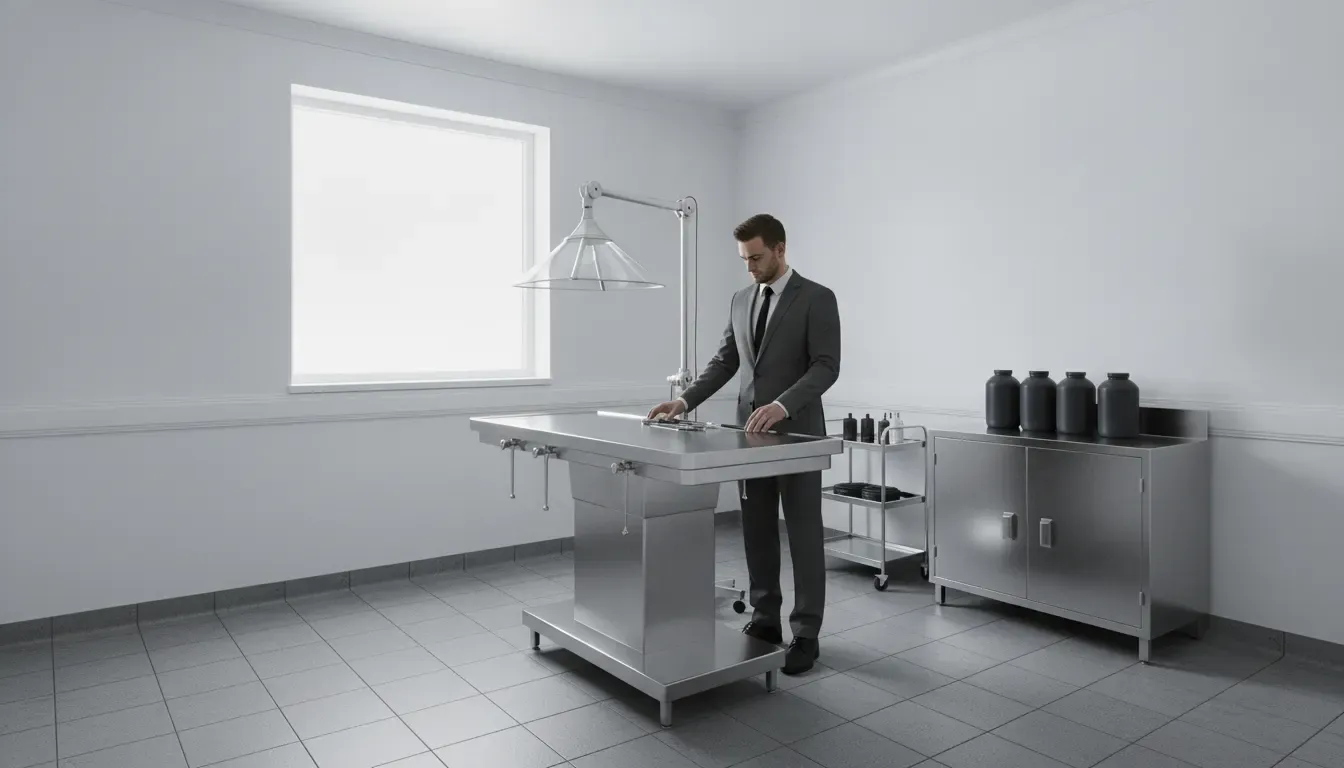
For funeral homes that use formaldehyde-containing embalming products, the OSHA formaldehyde standard is more than an exposure-limit table. It is a working program for identifying exposure, controlling the preparation room, training employees, responding to incidents, and keeping records. This formaldehyde standard funeral home checklist explains the major planning points in 29 CFR 1910.1048 so your team can have a more productive conversation with its safety professional.
Contact Vischer to discuss preparation-room equipment and safety-supply needs.
What does the formaldehyde standard require from a funeral home?
The OSHA formaldehyde standard requires an employer to evaluate occupational exposure, keep airborne concentrations within the applicable limits, and use controls before relying on personal protective equipment. The program also covers monitoring, regulated areas, hazard communication, training, medical surveillance when triggered, emergency planning, and records.
OSHA specifically addresses embalming and funeral-home work in an interpretation letter. It states that 29 CFR 1910.1048 applies to formaldehyde exposures from embalming and requires exposure monitoring, appropriate PPE, information, and training. The regulation applies to formaldehyde gas, solutions, and materials that release formaldehyde, not only to one named product.
Use the standard as a framework, not as a substitute for a site-specific assessment. The actual exposure profile depends on the products used, quantities, tasks, room design, ventilation, work practices, and employee time near the source.
What are the OSHA formaldehyde exposure limits?
OSHA sets an action level of 0.5 parts per million as an 8-hour time-weighted average, a permissible exposure limit of 0.75 ppm as an 8-hour TWA, and a 2 ppm short-term exposure limit over 15 minutes. The action level can trigger additional program duties before the PEL is exceeded.
| Term | Limit or meaning | Why it matters in a preparation room |
|---|---|---|
| Action level | 0.5 ppm as an 8-hour TWA | Use it as the threshold for additional monitoring and related program duties under the standard. |
| 8-hour TWA PEL | 0.75 ppm over an 8-hour workday | Controls must keep employee exposure at or below the applicable limit. |
| 15-minute STEL | 2 ppm during any 15-minute period | Short, high-exposure tasks need attention even when a full-shift average looks acceptable. |
| Employee exposure | Exposure assessed without credit for a respirator in use | Do not use a respirator to hide an uncontrolled source or avoid evaluating the room. |
These numbers are not a do-it-yourself pass or fail test. OSHA’s formaldehyde standard also specifies requirements for representative sampling, accuracy, employee notification, controls, and corrective action. A safety professional or qualified industrial hygienist can determine which measurements represent the work your team actually performs.
Review Vischer’s preparation-room equipment and supply categories.
How should a funeral home assess formaldehyde exposure?
Begin with a task-based exposure assessment. List the chemicals and formulations used, when containers are opened, how products are mixed or transferred, where aspiration or cavity treatment occurs, how spills are handled, and which employees may enter the room. Then identify the tasks and conditions most likely to create a full-shift or short-term peak exposure.
- Inventory sources. Review product labels, Safety Data Sheets, container sizes, concentrations, storage locations, and normal quantities used.
- Map the work. Note preparation tables, sinks, drains, local exhaust, general room air movement, doors, adjacent work areas, and employee positions.
- Identify higher-exposure tasks. Consider opening containers, pouring, mixing, aspiration, cleanup, spill response, and maintenance on control equipment.
- Identify affected employees. Include embalmers, assistants, cleaners, maintenance staff, and others who may enter the room or handle contaminated equipment.
- Choose a representative approach. Sampling should reflect the employee’s breathing zone and the full shift or short-term task conditions being evaluated.
OSHA allows an employer to avoid measurement only when objective data documents that foreseeable use cannot result in exposure at or above the action level or STEL. That is a documented determination, not an assumption based on room size, odor, or the fact that a facility has not received a complaint.
Which controls should be reviewed before PPE?
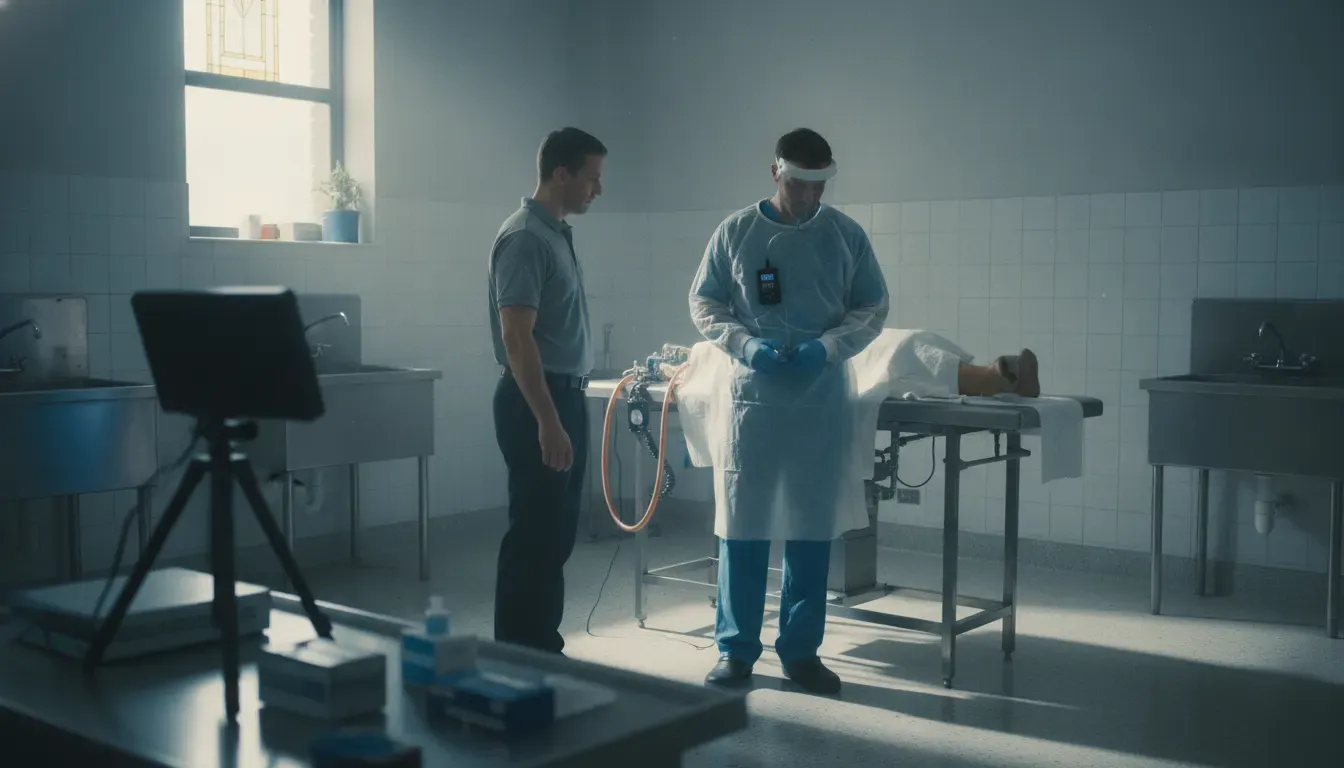
OSHA expects employers to use engineering and work-practice controls to reduce and maintain exposure at or below the TWA and STEL limits. In a funeral-home preparation room, that means reviewing source capture, room airflow, closed-container practices, task sequencing, cleanup, maintenance, and access before treating PPE or respirators as the primary answer.
- Engineering controls: Have a qualified professional evaluate local exhaust, capture location, makeup air, room pressure, discharge, and system performance under actual operating conditions.
- Work practices: Keep containers closed when not in use, use the smallest practical working quantity, avoid unnecessary splashing, and follow written transfer and cleanup procedures.
- Housekeeping: Inspect for leaks, residue, damaged containers, and contaminated surfaces. Keep control equipment and work areas maintained according to the facility’s program.
- Access control: Establish and post regulated areas when the standard’s conditions require them, and limit access to authorized, trained persons.
- Administrative coordination: Schedule maintenance, cleaning, and high-exposure tasks so the right people, controls, and emergency supplies are available.
A general room fan is not automatically local exhaust, and a pleasant room odor is not evidence of compliance. The control strategy should be evaluated against measured or objectively supported exposure conditions. Vischer’s embalming station and prep-room layout guide provides planning context, while the applicable OSHA standard and a qualified professional govern compliance decisions.
What should the PPE and respiratory protection plan cover?
PPE should be selected from the hazards identified in the assessment, including liquid contact, splash, eye exposure, contaminated clothing, and airborne exposure. The formaldehyde standard also points employers to respiratory protection requirements when respirators are required. PPE is part of a complete program, not a replacement for feasible engineering and work-practice controls.
- Review chemical protective gloves, gowns, aprons, eye protection, and face protection against the specific products and tasks.
- Pay particular attention to liquid products containing 1 percent or more formaldehyde, for which the standard includes specific eye, skin, and protective-clothing provisions.
- Define how contaminated clothing and equipment are removed, stored, cleaned, laundered, or disposed of without creating additional exposure.
- If respirators are required, coordinate the formaldehyde program with the applicable respiratory protection program, including medical evaluation, fit testing, training, and program administration.
- Keep PPE available, replace it when damaged or contaminated, and train staff to use it correctly.
Do not choose a respirator from a generic product list. Respirator selection depends on measured exposure, task conditions, cartridge or canister requirements, the full respiratory protection program, and the judgment of a qualified safety professional. For broader task-based PPE planning, review Vischer’s funeral home PPE requirements guide.
How do training, hazard communication, and medical surveillance fit together?
A compliant program connects the chemical inventory to employee information, accessible Safety Data Sheets, labels, training, and medical follow-up when the standard’s exposure thresholds or symptoms call for it. Training should be specific to preparation-room tasks and should explain how to recognize exposure, prevent contact, respond to spills, and report symptoms.
- Explain formaldehyde’s health hazards, exposure limits, warning signs, and routes of exposure.
- Show employees how to use labels, Safety Data Sheets, controls, PPE, and emergency equipment.
- Explain regulated-area boundaries and why only trained, authorized people may enter where the standard requires restricted access.
- Document training at assignment and when the program, products, equipment, or work practices change.
- Coordinate medical surveillance with the standard when employees are exposed at or above the action level or above the STEL, and respond promptly to symptoms that may be related to formaldehyde exposure.
Medical surveillance and training decisions belong in the employer’s occupational health and safety program. This article is an educational starting point, not medical or legal advice.
What records should the preparation-room program maintain?
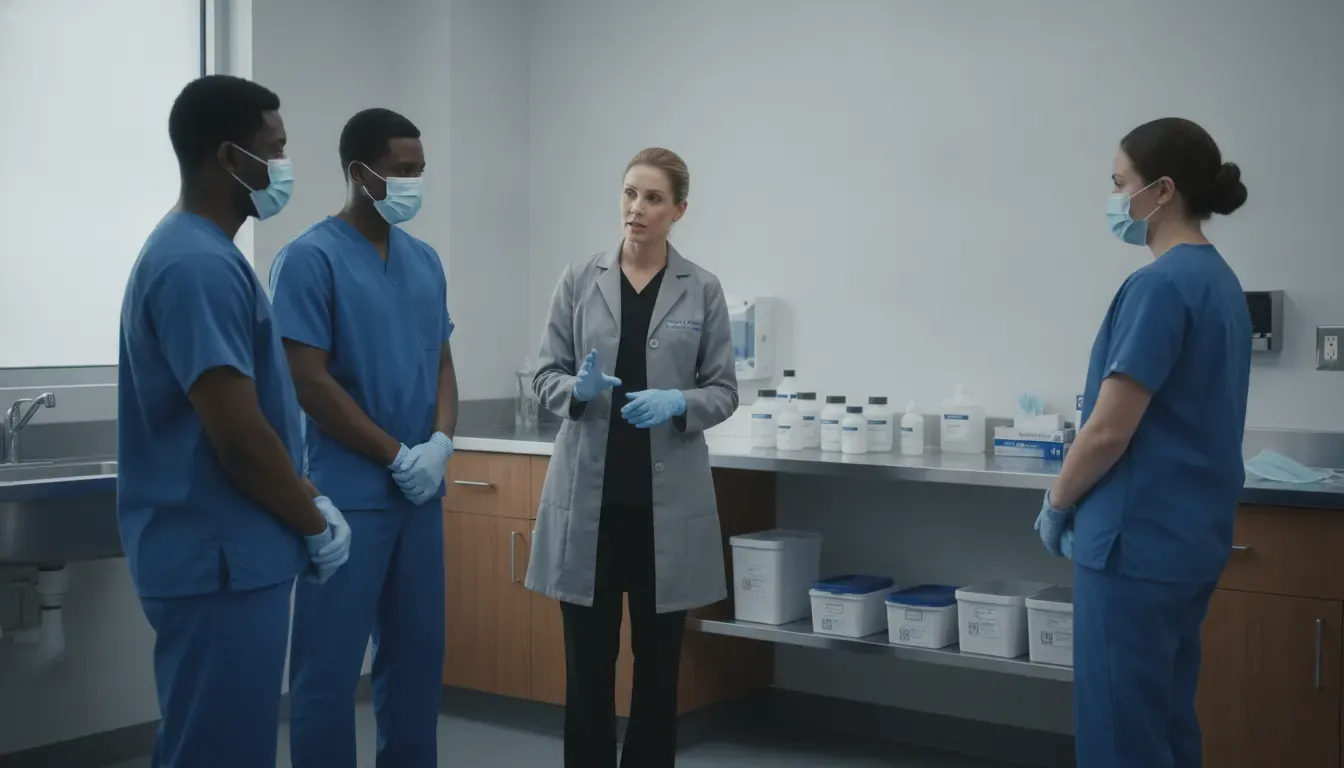
Records make the safety program reviewable and help the employer show what was assessed, what changed, and how employees were informed. Build a simple record system that follows the work from chemical receipt through exposure assessment, corrective action, training, medical follow-up, and retention.
- Current chemical inventory, labels, and readily accessible Safety Data Sheets.
- Objective data or exposure-monitoring plans, sampling results, laboratory information, and employee notifications.
- Ventilation and local-exhaust inspections, maintenance, repairs, and follow-up measurements.
- Written work practices, spill and emergency procedures, regulated-area decisions, and corrective actions.
- PPE and respirator training, fit-testing or program records when applicable, and replacement or inspection logs.
- Medical-surveillance records maintained through the appropriate occupational-health process.
OSHA’s recordkeeping details can depend on the type of record and the applicable rule. Keep records for the periods required by the standard and related OSHA requirements, and ask your safety professional or occupational-health provider to confirm retention and confidentiality practices.
Explore Champion embalming fluid and preparation supplies from Vischer.
What is a practical formaldehyde compliance checklist?
Use this checklist as a discussion tool for the person responsible for your facility’s safety program. It is designed to reveal missing decisions, not to certify compliance. Mark each item complete only when the facility has evidence that reflects its actual products, room, tasks, employees, and operating conditions.
- Identify every formaldehyde source and review its label and Safety Data Sheet.
- Map preparation-room tasks, employee breathing zones, adjacent areas, and higher-exposure conditions.
- Document whether objective data is sufficient or representative monitoring is needed.
- Compare monitoring or objective-data results with the 0.5 ppm action level, 0.75 ppm 8-hour TWA PEL, and 2 ppm 15-minute STEL.
- Review local exhaust, general ventilation, room layout, closed-container practices, and housekeeping.
- Define regulated areas, warning signs, and access rules when required.
- Confirm PPE, chemical-protective clothing, eye and face protection, and respiratory protection decisions.
- Train employees on hazards, labels, SDS access, controls, PPE, spills, emergencies, and symptoms.
- Coordinate medical surveillance and occupational-health follow-up when triggered by exposure or symptoms.
- Maintain monitoring, notification, training, maintenance, corrective-action, and medical records.
Frequently asked questions about the formaldehyde standard
Does OSHA’s formaldehyde standard apply to embalming in funeral homes?
Yes. OSHA states that 29 CFR 1910.1048 applies to formaldehyde exposures employees receive from embalming in funeral homes, as well as other occupational formaldehyde exposures. The facility still needs a site-specific evaluation of products, tasks, controls, and employee exposure.
What is the OSHA formaldehyde action level for a funeral home?
The action level is 0.5 ppm calculated as an 8-hour time-weighted average. It is lower than the 0.75 ppm 8-hour TWA permissible exposure limit and can trigger additional monitoring and related duties under the formaldehyde standard.
What is the formaldehyde short-term exposure limit?
The OSHA short-term exposure limit is 2 ppm over a 15-minute period. A facility should consider short, higher-exposure tasks as well as the full-shift average when planning monitoring and controls.
Can PPE alone make a preparation room compliant?
No. OSHA requires engineering and work-practice controls to reduce and maintain exposure at or below the applicable limits. PPE and respiratory protection may be necessary, but they should be selected and managed as part of the complete exposure-control program.
Is this checklist a substitute for an OSHA compliance review?
No. It is an educational planning aid. A qualified safety professional, industrial hygienist, occupational-health provider, or other appropriate advisor should evaluate the facility’s actual operations and confirm applicable federal, state, and local requirements.
Sources: OSHA 29 CFR 1910.1048, Formaldehyde; OSHA Appendix B, Sampling Strategy and Analytical Methods for Formaldehyde; OSHA interpretation for formaldehyde exposure in the embalming and funeral-home industry.