

Moving a casket through a chapel, viewing room, or transfer area calls for more than strength. The right equipment helps a funeral team work steadily, protect the casket, and maintain a dignified presentation from one setting to the next. For directors and removal staff, that makes the church truck an important part of everyday planning, not simply a piece of rolling equipment.
Church trucks for caskets are collapsible, portable platforms designed to support and move caskets during viewings, services, and transfers. Professional models may include adjustable supports, locking mechanisms, and capacities that commonly range from 400 to 1,000 pounds, depending on construction and model. Their folding design also makes them easier to store than a fixed display stand.
Before comparing materials, casters, and load ratings, it helps to understand exactly what a church truck is built to do and how its design supports safe, respectful movement. That definition provides the foundation for evaluating the features that matter most in a funeral home.
What Is a Church Truck for Caskets?
A church truck is a collapsible, portable wheeled platform designed to move and support a casket during funeral services, viewings, and transfers. It provides a stable base beneath the casket while allowing funeral professionals to guide it through the funeral home, chapel, church, or cemetery with controlled movement.
Unlike a simple cart intended for general hauling, a purpose-built church truck is designed around the dimensions, weight, and presentation requirements of a casket. Professional models commonly include adjustable casket supports, allowing the equipment to accommodate a range of casket sizes and dimensions. The supports help keep the casket properly positioned while staff move it between locations.
Church trucks are especially useful when a casket must be moved repeatedly during a service or visitation. They can be set up when needed, then folded for storage when the service is complete. That portability makes them practical for funeral homes that serve multiple chapels, churches, or cemetery settings. For a broader overview of selection considerations, see this church truck buying guide.
- Transport to the altar: Move the casket from a hearse or entry point to the altar or designated service area.
- Display during viewing: Provide a secure, appropriately positioned base for the casket throughout visitation.
- Cemetery transfer: Support controlled movement between the funeral coach, chapel, and cemetery equipment as conditions allow.
- Prep-room movement: Help staff transfer a casket within the facility without relying on a manual carry.
Using a church truck can also reduce the physical strain placed on pallbearers and funeral home staff. Rather than depending entirely on lifting strength, the team can focus on steering, positioning, and communicating during the move. That supports safer handling while preserving the quiet, dignified presentation families expect.
When evaluating church trucks for caskets, consider the truck’s capacity, locking and support mechanisms, wheel design, and storage requirements. The right equipment should make necessary movements more controlled without drawing attention away from the service itself.
Why Church Trucks Matter at Funeral Services
Church trucks give funeral home teams a controlled, respectful way to move and present a casket while reducing unnecessary physical strain. Their value is not limited to transportation. A well-designed truck supports the casket during transfers, helps staff maintain a composed presentation, and makes setup and storage more practical in busy facilities.
Moving a casket by hand can place uneven demands on pallbearers and staff, particularly when navigating doorways, carpet transitions, ramps, or tight service areas. A wheeled platform allows one trained operator to guide the load when conditions permit, rather than asking several people to lift and reposition it repeatedly. Staff should still follow their funeral home’s lifting procedures and assess the load, route, and number of people needed before every movement.
- Reduces lifting strain: Wheels and a stable frame can limit repeated lifting during positioning and transfers.
- Stabilizes the casket: A supported platform helps keep the casket steady while it is moved into place or aligned for a service.
- Folds for compact storage: A collapsible design takes up less room between services and can be transported more easily.
- Uses quiet wheels: Smooth, quiet movement helps preserve the calm atmosphere expected during a viewing or funeral service.
Dignity is also an operational consideration. Controlled movement helps reduce abrupt shifts, unnecessary handling, and visible improvisation in front of families. When the casket remains supported and level, staff can focus on the service rather than correcting equipment-related movement.
Church trucks are designed to be portable and collapsible, making them useful across services, viewings, and transfers. The X-frame found on many models supports stability while allowing the truck to fold efficiently for setup and breakdown. Review the church truck buying guide when comparing frame design, capacity, and handling requirements for your facility.
Church Trucks vs. Casket Biers: The Key Differences
Church trucks are designed for movement and storage, while casket biers are generally intended to provide a stable, presentable place to display a casket. The right choice depends on whether your priority is transporting a casket between locations, maintaining a display in one room, or handling both needs with separate equipment.
Although the terms are sometimes used interchangeably, the designs serve different operational purposes. A church truck typically uses a folding X-frame, casters, and adjustable supports. A bier is more often a stationary or decorative stand with fixed legs. That distinction matters when equipment must move through chapel aisles, over thresholds, into a hearse, or back into storage after a service.
| Consideration | Church truck | Casket bier |
|---|---|---|
| Portability/Collapse | Portable and typically collapsible for setup, transfers, and storage. | Usually stationary, with a fixed or less portable display structure. |
| Wheels | Built with casters or wheels for controlled movement across suitable surfaces. | Often has fixed legs rather than rolling casters. |
| Adjustability | Many models offer adjustable supports to fit different casket sizes. | Typically offers less adjustment because it is designed as a display stand. |
| Carrying | Supports moving a casket during services, viewings, and transfers. | Primarily supports a casket while it remains in a designated display position. |
| Storage | Folding construction can reduce the footprint between uses. | Fixed legs generally require dedicated floor or equipment-room space. |
| Best Use | Funeral services, chapel movement, transfers, and teams that need flexible equipment. | Stable, decorative presentation where the casket will remain in place. |
When a church truck is the better fit
Choose a church truck when staff regularly move caskets or when one piece of equipment must serve several rooms and procedures. Casters reduce the need to lift and carry the full load. While a collapsible frame makes it easier to keep the truck ready without permanently occupying chapel or preparation-room space. Adjustable supports can also make a truck more versatile when the funeral home serves families selecting different casket sizes.
Portability does not mean every truck is appropriate for every route. Review the wheel design, floor transitions, doorway clearances, and terrain where the equipment will be used. A model intended for smooth indoor flooring may not be the right choice for outdoor cemetery paths. For a closer look at available equipment, review Vischer’s church trucks and cemetery biers.
When a casket bier may make more sense
A bier can be appropriate when the primary need is a stable presentation in a chapel, viewing room, or other designated space. Its fixed structure may suit a funeral home that does not need to roll the casket between locations and values a consistent display arrangement. Because a bier is not typically built around folding and transport, confirm its dimensions, support points, and rated use before ordering.
Some funeral homes may benefit from keeping both types of equipment available. A bier can support a planned display, while a church truck can handle movement, transfers, and situations where storage flexibility is important. Compare the equipment to your actual workflow rather than choosing based on the name alone.
Construction That Stands Up: Anodized Aluminum and the X-Frame
The best church trucks for caskets balance low weight with dependable support, using corrosion-resistant materials. A stable folding frame, and contact points that keep the casket secure during movement.
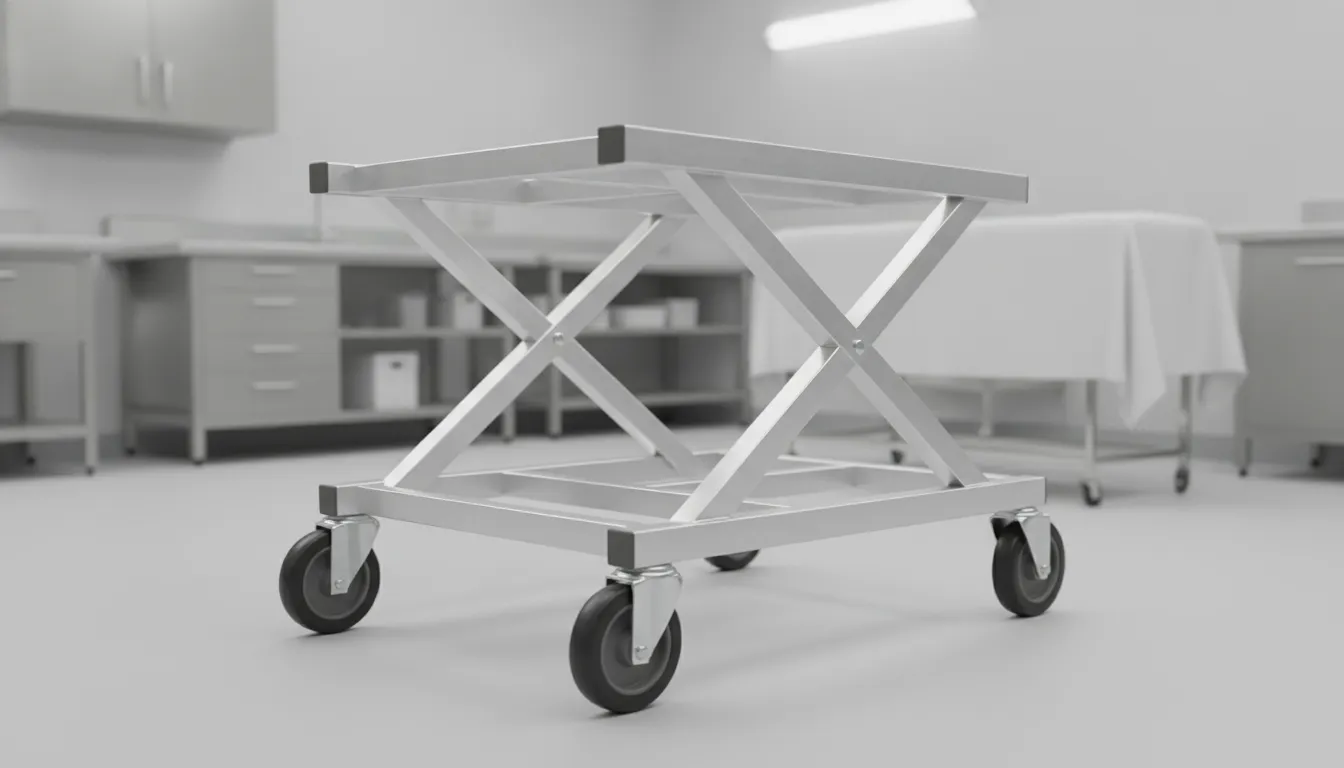
Material selection matters because funeral home staff may need to position, store, and move the truck repeatedly throughout the week. Rectangular aluminum tubing provides a useful combination of strength and portability. An anodized finish adds a hard protective surface that is easy to wipe clean and helps the truck retain a bright, professional appearance over time. These practical details support both routine maintenance and the dignified presentation expected in a chapel or service setting.
The X-frame undercarriage is another important design feature. Its geometry spreads support beneath the load while allowing the truck to fold efficiently for storage or transport. A well-designed frame should open smoothly, lock firmly, and remain stable once positioned. Folding efficiency is especially valuable for funeral homes that move equipment between chapels, visitation rooms, garages, and vehicles.
- Rectangular anodized aluminum tubing: Delivers structural strength without making the truck unnecessarily difficult to carry or reposition.
- Protective glossy finish: Makes surfaces easier to clean and helps maintain a polished appearance.
- Stable X-frame undercarriage: Supports the casket while allowing efficient setup and breakdown.
- Rubber rests: Provide cushioned contact points that help keep the casket in place.
- Rubber tires: On suitable models, six-inch tires can roll quietly across carpet, thresholds, and other common indoor obstacles.
The Ferno Model 87 illustrates how these features work together. Its rectangular aluminum tubing, anodized finish, X-frame undercarriage, and rubber rests are designed for regular professional use. The model is rated for a 1,000-pound load while weighing approximately 35 pounds. Giving operators a concrete example of how a truck can provide substantial capacity without becoming cumbersome when empty. It also locks into four positions to accommodate a range of casket sizes, although every facility should confirm dimensions and operating procedures before selecting equipment.
Construction cannot replace proper inspection or trained handling. Before use, staff should check that the frame opens and locks correctly, the rests are intact, and the wheels move as expected. A clean, stable truck is easier to operate confidently and helps protect both the equipment and the people entrusted with each transfer.
What Should You Look for in Church Trucks for Caskets?
Answer capsule: Choose a church truck by matching its load rating, adjustment range, wheel design, finish, and warranty to the way your funeral home moves and displays caskets. A truck that fits your facilities and routes will support safer handling while maintaining a composed, dignified presentation.
Start with the truck’s capacity, not its appearance. Standard church trucks generally support between 400 and 1,000 pounds, depending on the model and construction. Select a rating that accommodates the casket and its contents with an appropriate operating margin. Rather than choosing a model that is only barely rated for your typical load. As a reference point, the Ferno Model 87 has a 1,000-pound load limit and weighs 35 pounds. Product specifications and your own handling procedures should guide the final choice.
Match the truck to your caskets and facilities
Dimensions matter as much as weight. Professional models commonly use adjustable casket supports so one truck can accommodate a range of casket sizes. The Ferno Model 87, for example, locks into four positions and adjusts from 15.25 to 61.25 inches in length. Before ordering, measure the caskets you use most often, along with chapel entrances, aisles, thresholds, storage areas, and any tight turns where staff will maneuver the truck.
- Confirm the load capacity for the casket configurations your team handles.
- Check the adjustment range against your smallest and largest regularly used caskets.
- Verify the truck’s width and height against aisles, doorways, sills, and display locations.
- Consider how easily staff can fold, carry, store, and set up the truck between services.
- Ask about the manufacturer’s warranty, replacement parts, service support, and expected lead time.
Choose casters for the route, not just the showroom
Wheel selection should reflect the surfaces the truck will cross. Six-inch rubber tires are well suited to carpet, interior flooring, and door sills because they roll quietly over modest obstacles. If the truck will travel regularly across cemetery grounds or other uneven outdoor surfaces, look for a cemetery-oriented design with larger or pneumatic casters. The larger footprint can make rough terrain easier to manage, but it may also affect storage and maneuverability indoors.
- Six-inch rubber tires: A practical choice for carpet, chapel floors, and sills, with quiet rolling for services.
- Larger casters: Useful when routes include uneven thresholds, outdoor paths, or more demanding transitions.
- Pneumatic casters: Worth considering for frequent cemetery use and rougher ground, provided staff can maintain them properly.
Review construction, finish, and long-term support
Anodized aluminum tubing can provide a useful balance of low weight, durability, and easy cleaning. An X-frame undercarriage can add stability while allowing efficient folding, and rubber rests help keep the casket supported during movement and display. Finish options are primarily a facility and appearance decision, but a protective finish that stays clean and presentable supports professional standards during public-facing services.
Finally, compare brands on more than initial price. Confirm the warranty period, what it covers, and whether the supplier can help identify compatible parts or accessories. A short conversation with an equipment specialist can reveal fit or terrain issues before they affect a service. For more selection guidance, review the church truck buying guide.
How to Use and Maintain a Church Truck Safely
A short inspection before every use, followed by routine cleaning and storage, helps keep a church truck stable, predictable, and ready for respectful service.

Safe operation is not limited to the moment a casket is placed on the truck. The frame, rests, casters, wheel bearings, and locking points all contribute to controlled movement. Use the following sequence as a practical maintenance routine, while also following the manufacturer’s instructions for the specific model.
- Inspect the frame and rubber rests before each use. Look for bent tubing, loose fasteners, cracks, worn rubber, or anything that could allow the casket to shift. Confirm that the support surfaces are clean and seated correctly. OSHA guidance recommends inspecting hand trucks before each use to confirm that they are in good working condition. See the OSHA hand-truck safety guidance for related material-handling principles.
- Clean the casters and wheel bearings. Remove hair, dirt, grit, and other debris that can restrict rolling or cause a caster to track unevenly. Check each wheel for wobble or unusual resistance. A church truck should roll smoothly across the surfaces where it will be used, including carpet transitions and doorway sills.
- Test the locking mechanism. Operate every adjustment and lock before loading the casket. Make sure the mechanism engages fully, releases when intended, and holds the selected position without slipping. Do not use the truck if a lock is difficult to engage or cannot maintain a secure setting.
- Wipe down the anodized finish. Use a clean, soft cloth and an appropriate mild cleaner to remove dust, residue, and handling marks. Dry the surfaces afterward. Avoid abrasive pads or harsh chemicals that could dull or damage the finish.
- Lubricate moving joints as recommended. Apply the lubricant specified by the manufacturer to hinges, pivots, or other moving joints. Use it sparingly and wipe away excess so it does not transfer to the casket, drapes, flooring, or hands. If a joint remains stiff after lubrication, have the truck evaluated rather than forcing it.
- Store the truck folded in a dry place. Fold it only after cleaning and checking that the moving parts are free. Keep it away from standing water, excessive humidity, corrosive chemicals, and areas where it could be struck by other equipment. Secure the folded truck so it cannot fall or obstruct an aisle.
Operator practices matter just as much as equipment condition. Use material-handling equipment to reduce lifting demands and musculoskeletal strain, and ensure staff are trained in its safe use, as recommended in OSHA material-handling guidance. When handling remains, follow Standard Precautions and wear appropriate PPE for the task, with additional protection when splashing is possible. The CDC guidance on handling remains provides the relevant infection-prevention framework.
Ready to equip your funeral home with church trucks for caskets? Call 800-752-8767 today.
Frequently Asked Questions
What is a church truck used for in funeral services?
A church truck is a portable, collapsible platform used to move and position caskets during viewings, funeral services, and transfers. Its wheeled design helps staff maintain controlled movement while presenting the casket with dignity.
How much weight can a standard church truck hold?
Capacity depends on the model, construction, and adjustment range. Standard church trucks commonly support between 400 and 1,000 pounds, so confirm the manufacturer’s rated capacity against the casket and total load before use. Review manufacturer specifications for the specific model.
What is the difference between a church truck and a casket bier?
A church truck is designed to fold, store, and move between locations. A casket bier is generally a stationary or decorative display stand intended primarily for presentation. Choose a truck when portability and transport are priorities, and a bier when a fixed display is the main need.
Are church trucks adjustable for different casket sizes?
Many professional models use adjustable supports or locking positions to accommodate different casket dimensions. Check the model’s minimum and maximum length, width, height, and support configuration before purchasing, then secure the casket according to the manufacturer’s instructions.
How do you maintain a funeral church truck?
Inspect the frame, supports, wheels, and locking mechanisms before each use. Clean casters regularly, test locks, and remove equipment from service if a wheel, fastener, or support is damaged. OSHA recommends inspecting hand trucks before use and training employees in safe material-handling equipment practices: OSHA hand-truck guidance.
Ready to Furnish Your Funeral Home?
The right church truck can support safer movement, a dignified presentation, and smoother coordination for your funeral home team. If you are comparing capacities, wheel options, casket fit, or maintenance needs, the Vischer team can help you evaluate the choices for your daily work. Contact us to talk with the Vischer team about church trucks for caskets.